
Aesthetic clinic marketing is defined as the strategic use of positioning, digital channels, and patient engagement systems to attract, convert, and retain high-value clients. Done well, it is the single biggest driver of sustainable revenue growth for clinics across the UK. Referral leads close at approximately 70%, compared to 30–40% for cold paid traffic. That gap alone tells you where your marketing energy should go. This guide covers the tools, tactics, and common mistakes that separate fully booked clinics from those stuck chasing enquiries.
How to position your aesthetic clinic in a competitive market
Positioning is the foundation of effective aesthetic clinic marketing. It answers one question for a prospective patient: “Why should I choose you over the clinic down the road?” Generic answers like “we care about results” do not work. Specific answers do.
Clinics with sharp positioning attract and retain more high-value patients than those with broad, vague messaging. Specificity builds trust before a patient ever picks up the phone. A clinic that leads with “London’s only CQC-registered clinic specialising in non-surgical rhinoplasty for South Asian skin tones” is far more memorable than one that says “we offer a full range of treatments.”

Your positioning should reflect three things: your specialist procedures, your credentials, and the patient outcome you deliver. Each of these gives a prospective patient a concrete reason to choose you. Credentials matter especially in the City of London market, where clients are discerning and research-led.
Your website and branding must reflect your positioning consistently. A website built to convert uses real before-and-after photos, clear calls to action, and mobile-friendly design. It functions as a booking engine, not a digital brochure.
Pro Tip: Ask your best existing patients why they chose you and why they stayed. Their exact words are your positioning. Use those phrases in your website copy, social captions, and Google Business Profile description.
-
Lead with one specialist procedure or patient outcome, not a full treatment menu
-
List your qualifications and registrations prominently on your homepage
-
Use patient language, not clinical terminology, in all public-facing copy
-
Align your visual identity (colours, photography, typography) with the price point you want to command
What digital tools does an aesthetic clinic need?
Google Business Profile is the highest-leverage asset for local patient acquisition in 2026. Patients searching “aesthetic clinic near me” in the City of London see the map pack first. Low review volume means missed bookings, full stop. Actively requesting reviews after every appointment is not optional; it is a core part of your marketing system.
Local SEO sits directly beneath Google Business Profile in terms of priority. Your website needs location-specific pages, consistent NAP (name, address, phone) data across directories, and content that targets the procedures your patients search for. Aesthetic clinic SEO is not about ranking nationally. It is about owning your postcode.
Paid advertising works best with a structured funnel. High-performing clinics use a three-layer ad funnel covering awareness, consideration, and conversion. This approach costs 3–5 times less per consultation than targeting cold audiences directly. The most effective paid campaigns use retargeting and audience warming rather than sending cold traffic straight to a booking page.
Email and SMS are the most underused channels in digital marketing for clinics. Monthly newsletters and quarterly SMS campaigns generate 12–18% of total monthly revenue from existing patient lists. That is revenue from people who already trust you, requiring no new acquisition spend.
| Channel | Primary purpose | Typical impact |
|---|---|---|
| Google Business Profile | Local discovery and bookings | Highest local acquisition leverage |
| Local SEO | Organic search visibility | Long-term, compounding traffic |
| Paid ads (three-layer funnel) | New patient acquisition | 3–5x lower cost per consult vs. cold traffic |
| Email and SMS | Retention and re-engagement | 12–18% of monthly revenue |
| Social media (local, engaged) | Brand awareness and trust | Supports conversion, not a direct booking driver |
How to build a marketing system that fills your appointment book
A marketing system maps every stage of the patient journey: awareness, consideration, consultation, decision, and retention. Most clinics invest heavily in awareness and then lose patients at the consultation stage. Top practices close 55–70% of consultations, while the median sits at 25–35%. Structured follow-up recovers 20–30% of undecided patients. That gap is a training and process problem, not a marketing spend problem.
Here is a practical system you can build in stages:
-
Set up your Google Business Profile fully. Add photos, services, and a booking link. Request reviews from every patient after their appointment.
-
Publish two location-specific SEO pages targeting your top two procedures in your area.
-
Build a three-layer paid ad funnel. Run awareness content (educational videos, before-and-after carousels) to a warm audience, then retarget with a consultation offer.
-
Create an email sequence for new enquiries. Send a welcome email within one hour, a follow-up at 48 hours, and a final nudge at seven days.
-
Launch a referral programme. Offer a meaningful reward (a treatment credit, not a discount) to existing patients who refer a friend.
-
Set up a monthly newsletter and quarterly SMS campaign for your existing patient list.
-
Train your front desk team on consultation conversion. Script the first 60 seconds of every consultation call.
Combining referral programmes with digital channels compounds patient acquisition over time. Referrals bring in high-intent patients who already trust you because a friend recommended you.
Pro Tip: The biggest follow-up mistake is waiting too long. Most clinics follow up once, three days later. The highest-converting practices send a personalised message within 24 hours and reference the specific treatment the patient enquired about. Generic follow-ups get ignored.
Common mistakes in aesthetic clinic marketing
The most expensive mistake is chasing social media follower counts. A smaller, engaged local audience consistently outperforms a large, non-local one. A clinic with 800 engaged local followers is often fully booked. A clinic with 15,000 followers spread across the country is not.
-
Vanity metrics over bookings. Measure enquiries, consultations booked, and treatments completed. Follower counts and likes do not pay the rent.
-
Over-discounting. Controlled discounting and membership tiers preserve margins and brand value. Blanket discounts train patients to wait for deals and devalue your services.
-
Skipping consultation training. Your front desk team is your highest-leverage conversion asset. Untrained staff lose patients that your marketing budget worked hard to attract.
-
Spreading across too many channels. Own two or three channels well before adding more. Thin presence everywhere produces results nowhere.
-
Not tracking cost per booking. If you do not know what each new patient costs to acquire, you cannot make informed decisions about where to spend your budget.
How do you measure aesthetic clinic marketing performance?
Patient lifetime value and retention rates are the key indicators of long-term growth. Tracking these tells you whether your marketing is attracting the right patients, not just any patients. A patient who books once and never returns has a very different value to your business than one who visits four times a year.
The metrics every clinic should track are:
-
Cost per booking: total marketing spend divided by new bookings in a period
-
Consultation conversion rate: percentage of consultations that result in a treatment booking
-
Patient retention rate: percentage of patients who rebook within 12 months
-
Revenue per patient: average spend per patient across their lifetime with your clinic
-
Source attribution: which channel (Google, referral, social, paid) drove each new patient
A CRM system makes source attribution possible. Without one, you are guessing. Even a simple spreadsheet tracking enquiry source, consultation outcome, and treatment booked gives you enough data to make better decisions.
Pro Tip: Set a 90-day review cycle for your marketing performance. Review your cost per booking and consultation conversion rate every quarter. Adjust your budget towards the channels producing the lowest cost per booking, and cut spend on channels that are not converting.
Key takeaways
Effective aesthetic clinic marketing combines sharp positioning, local SEO, a structured patient acquisition funnel, and consistent retention activity to drive sustainable, compounding growth.
| Point | Details |
|---|---|
| Positioning drives everything | Specific, credential-led positioning attracts higher-value patients and makes all other marketing more effective. |
| Google Business Profile is non-negotiable | Review volume directly determines how many local patients find and book your clinic. |
| Referrals outperform cold traffic | Referral leads close at approximately 70%, making referral programmes the highest-ROI marketing investment. |
| Retention revenue is underused | Monthly newsletters and SMS campaigns generate 12–18% of monthly revenue from existing patients at minimal cost. |
| Measure cost per booking | Tracking cost per booking and consultation conversion rate tells you exactly where to spend and where to cut. |
What I have learned from working with aesthetic clinics
The clinics that grow fastest are not the ones with the biggest marketing budgets. They are the ones with the clearest message. Every time I have seen a clinic struggle to fill its appointment book, the root cause has been the same: they are trying to be everything to everyone, and no one can tell what makes them different.
The second pattern I see repeatedly is clinics investing heavily in paid ads without fixing their consultation conversion rate first. Sending 100 enquiries to a team that closes 25% of them is far less profitable than sending 60 enquiries to a team that closes 65%. The maths is straightforward. Train your team before you scale your ad spend.
Multi-channel marketing does compound over time, but only if you are consistent. The clinics I have seen build real, lasting growth are the ones that showed up every month with a newsletter, kept their Google Business Profile updated, and asked every happy patient for a referral. None of those things are glamorous. All of them work.
Patience matters more than most clinic owners expect. Aesthetic clinic SEO takes three to six months to produce meaningful results. Referral programmes take time to embed into your patient culture. The clinics that give up after eight weeks never see the return. The ones that stay consistent for six months usually cannot keep up with demand.
— Luke
How Jarvisandco can support your clinic’s growth
If your clinic’s website is not converting visitors into booked consultations, the design and messaging are likely the problem. Jarvisandco specialises in branding and website design for businesses across the UK, with over 15 years of experience building digital presences that generate real enquiries.
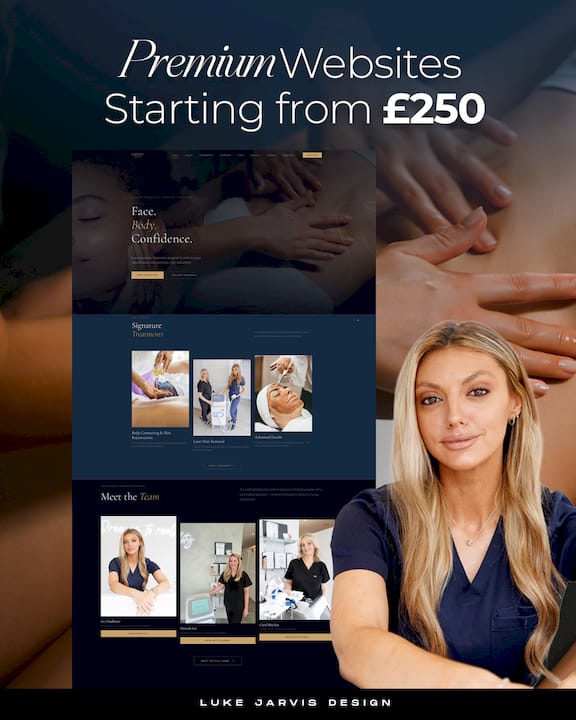
Jarvisandco creates websites built to convert, not just to look good. From positioning and visual identity to SEO and social media, the team handles the full picture. If you want a clinic brand that stands out in a crowded market and a website that works as hard as you do, get in touch with Jarvisandco for a consultation.
FAQ
What is aesthetic clinic marketing?
Aesthetic clinic marketing is the use of positioning, digital channels, and patient engagement systems to attract and retain high-value clients. It covers local SEO, paid advertising, referral programmes, and retention activity.
How do I market my aesthetic clinic on a limited budget?
Start with Google Business Profile optimisation and a referral programme. Both require minimal spend and produce strong returns. Monthly email newsletters to your existing patient list also generate revenue at very low cost.
What is the best social media strategy for aesthetic clinics?
Focus on building a small, engaged local audience rather than chasing follower counts. Local followers who can actually book with you are far more valuable than a large, geographically spread audience that cannot.
How long does aesthetic clinic SEO take to show results?
Local SEO typically produces measurable results within three to six months. Consistent content, a fully optimised Google Business Profile, and location-specific pages accelerate the process.
How do I measure whether my clinic marketing is working?
Track cost per booking, consultation conversion rate, and patient retention rate. These three metrics tell you whether your marketing is attracting the right patients and whether your team is converting them effectively.