Use a brochure for a quick, folded handout; use a booklet when you need a bound, multi-page guide. That's the whole rule of thumb, and it holds true whether you're pushing out a flyer for a trade show or a full product catalogue for a sales team.
- Brochure: single sheet, folded, cheaper, made to be glanced at and binned or kept for a week.
- Booklet: multiple pages, bound, pricier per unit, made to be kept and referred back to.
We'll cover exact fold types, binding rules, paper specs, and a decision checklist later in this piece, so you can walk into a print quote knowing exactly what to ask for.
Key Takeaways
The right choice between a brochure and a booklet comes down to content depth, distribution method, and whether the reader needs to keep the document.
| Point | Details |
|---|---|
| Match format to content volume | Choose a brochure for a message under three panels; choose a booklet once you need sections or a contents page. |
| Respect binding page rules | Saddle stitch requires page counts in multiples of four and works up to roughly 92 pages. |
| Pair formats for better results | Use a brochure to attract attention first, then follow up with a booklet once interest is confirmed. |
| Paper weight signals value | Heavier cover stock and finishes like spot UV lift perceived quality more than layout changes alone. |
| Get a done-for-you brief | Jarvis & Co's print design service handles format selection, proofing, and printer liaison in one process. |
Table of Contents
- What is a brochure? Definitions, folds, and when to use one
- What is a booklet? Binding types, page counts, and core uses
- Key differences at a glance
- Decision checklist: when to choose a brochure, when to choose a booklet
- Production practicals: sizes, paper stock, binding, and finish
- What marketers get wrong about choosing between the two
- Sources
What is a brochure? Definitions, folds, and when to use one
A brochure is a single sheet, printed on both sides and folded into panels. That's the whole format. It's built for a message that can be read in under a minute, then acted on or handed to a colleague.
The fold you choose changes how the reader experiences the message. A bi-fold gives you four panels, simple and direct. A tri-fold offers six, with one panel working as a teaser before the reader opens it fully. A Z-fold reveals content in sequence, which suits step-by-step information such as a process or a "how it works" explainer. Gate-folds open outwards from both edges and suit a big reveal image or a premium product shot.
- Bi-fold — quick overviews, service lists, event flyers.
- Tri-fold — the classic sales brochure, good for a teaser cover and three-stage message.
- Z-fold — instructions, timelines, anything sequential.
- Gate-fold — premium launches, property brochures, anything that benefits from a reveal.
Brochures typically run on a single heavier stock, often between 130gsm and 200gsm, which keeps unit cost low even at high volumes.
Pro Tip: Design your brochure's front panel to work as a standalone advert. Most people see it folded shut on a counter or in a rack before they ever open it.
What is a booklet? Binding types, page counts, and core uses
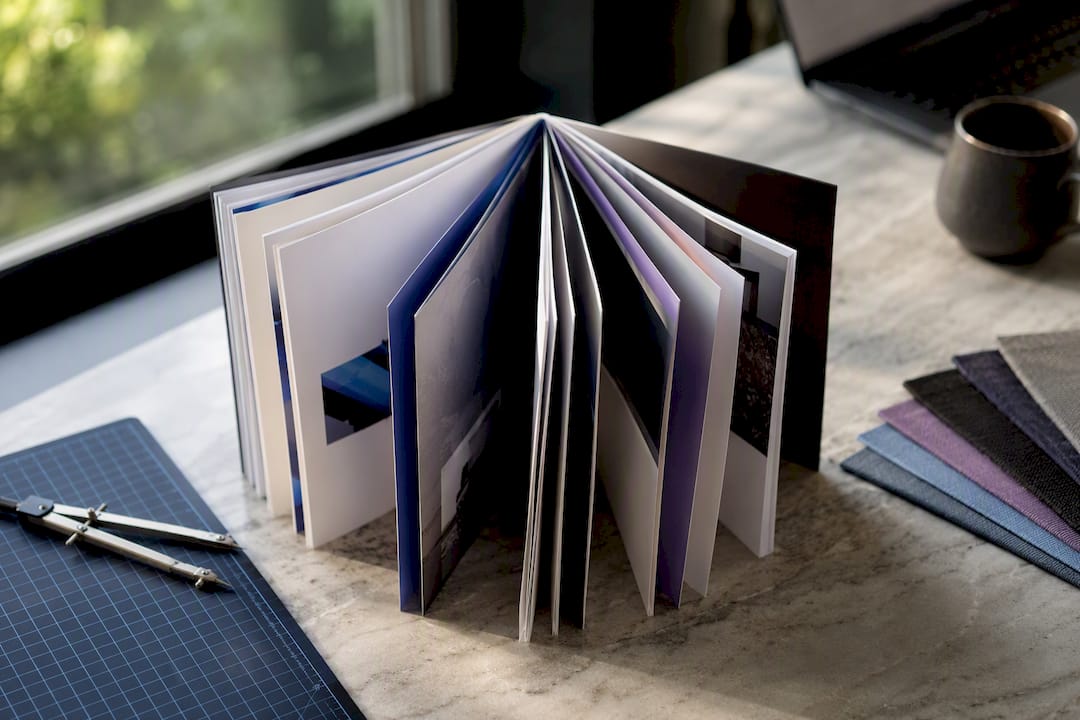
A booklet is a bound, multi-page document, and that single distinction, bound versus folded, is what separates it from a brochure. Where a brochure delivers one idea fast, a booklet carries depth: pricing tables, full product ranges, technical instructions, or a full event programme.
Three binding methods cover almost every use case:
- Saddle stitch — stapled through the spine, cost-effective, and suitable up to roughly 92 pages.
- Perfect bind — glued flat spine, used for higher page counts or when you want a more premium, book-like finish.
- Spiral or wire-o — allows the booklet to lie flat or fold back fully, ideal for manuals and workbooks people will actually use at a desk.
Here's the number that catches most first-time buyers out: saddle-stitch page counts must fall in multiples of four. That's not a printer being fussy, it's how single sheets nest and fold together inside the spine. Specify 18 pages and you'll either pad it to 20 or switch binding method entirely.
Booklets show up as product catalogues, instruction manuals, event programmes, annual reports, and training guides. Anywhere a reader needs to keep coming back to the document, a booklet earns its higher cost.
Key differences at a glance
The practical distinction comes down to content volume and purpose. Brochures are for quick overviews and immediate calls to action; booklets carry the depth needed for pricing, product ranges, and instructions.
- Format and construction: brochures fold; booklets bind. That's the structural line that decides everything else.
- Page or panel count: brochures typically offer 4 to 8 panels; booklets start around 8 pages and can run to hundreds.
- Durability and perceived value: a bound document with a heavier cover reads as more valuable and gets kept longer than a folded sheet.
- Distribution and lifecycle: brochures suit mass handouts, mailers, and counter displays; booklets suit direct requests, event packs, and reference material people file away.
- Relative cost: brochures cost less per unit and print faster; booklets cost more per unit but justify that cost when the reader needs to retain the material.
Decision checklist: when to choose a brochure, when to choose a booklet
Run your campaign brief through a few honest questions before you commit a print budget.
- How long is your message? If it fits in three panels of copy and one hero image, it's a brochure. If it needs sections, headers, and a contents page, it's a booklet.
- How much attention will the reader give it? A trade show visitor scanning tables for ten seconds needs a brochure. A prospect who has already booked a call and wants the full service breakdown needs a booklet.
- How will it be distributed? Mass mailers, counter racks, and door drops favour brochures because unit cost stays low at volume. Requested downloads, sales meetings, and mailed follow-ups justify a booklet's higher cost.
- What's your print run and budget? Large runs of a simple message push you towards brochures. Smaller runs of high-value material push you towards booklets, where the per-unit cost matters less than the impression it makes.
- Does the reader need to keep it? If the answer is yes, a booklet's binding and cover weight signal that the document is worth filing rather than binning.
Pro Tip: Don't force one format to do both jobs. Many printers see the strongest results when a short brochure attracts attention first, then a booklet gets mailed or handed over as a leave-behind once someone shows real interest. That two-stage approach also works well alongside a wider integrated marketing campaign where print and digital touchpoints reinforce the same message.
If your campaign spans both channels, brochures and websites, it helps to think about how printed assets support your lead generation rather than treating print as a standalone effort.
Production practicals: sizes, paper stock, binding, and finish
Once you've settled on a format, the printer brief is where projects either go smoothly or get delayed by revisions. Standard brochure sizes are A4 folded to A5 or DL, with panel widths adjusted slightly so folded panels nest correctly rather than catching on each other.
Paper choice differs by format. Brochures often use a single heavier stock, 130gsm to 200gsm, because there's only one sheet to carry the whole impression. Booklets split the job: a heavier cover, typically 200gsm to 300gsm, protects the piece and signals quality, while the inside pages run lighter, usually 80gsm to 120gsm, keeping the finished booklet manageable to hold and post.
Binding limits matter at the brief stage, not after proofing. Saddle stitch works cleanly up to roughly 92 pages; beyond that, perfect binding gives a flatter spine and a more premium feel. Remember the multiples-of-four rule for saddle stitch, and build it into your content plan before copy is finalised, not after.
Finish choices, lamination, spot UV, or embossing, add cost but also add perceived value. Increasing cover weight or adding a spot UV highlight tends to lift how premium a document feels more than incremental layout tweaks. If your brief needs printer-ready measurements for other materials too, our business card size guide shows the level of detail worth including in any print specification.
Agency perspective: design and messaging tips from Jarvis & Co
Brochures work hardest with one clear call to action and a strong visual hierarchy guiding the eye there. Booklets need the opposite discipline: consistent section headers and a contents page once you pass a handful of pages.
Higher paper weight and proper binding pay off most on premium offers, where the reader's first physical impression of the document shapes how seriously they take the pitch. For B2B service guides and product catalogues, a bound booklet nearly always outperforms a folded brochure on perceived credibility.
What marketers get wrong about choosing between the two
Most guidance on this topic treats brochure versus booklet as a stylistic choice, when it's really a logistics decision dressed up as a design one. The format follows the content and the distribution plan, not the other way round. Get the brief backwards, decide on the format first and squeeze the copy to fit, and you end up with a cramped tri-fold trying to carry a full price list, or a 12-page booklet padded with white space because nobody had enough to say.
The checklist earlier in this piece matters more than any layout advice. Page count, binding method, and paper weight aren't finishing touches, they're decisions that lock in before a single word of copy gets written. A saddle-stitch booklet specified at 18 pages instead of 20 isn't a rounding error, it's a reprint.
What gets underrated is pairing formats deliberately. A short brochure for the first touch, a booklet as the follow-up once someone's shown interest, does more for a pipeline than either format working alone. If you take one thing from this article, let it be that: decide the reader's journey first, then let the format follow.
How Jarvis & Co can help with brochures and booklets
Jarvis & Co is the alternative to guessing your way through a print quote. We handle brochure and booklet design in-house, from panel layout and paper specification through to proofing and liaising directly with printers, so you're not translating between a designer and a print shop yourself.
Working with us starts with a short brief covering your message, audience, and distribution plan. From there we recommend the format, fold or binding, and paper stock, produce proofs for your sign-off, and manage production through to delivery. If you've got a campaign that needs a brochure, a booklet, or both working together, get in touch through our print design service and we'll turn your brief into a printer-ready spec.
Sources
- Brochure printing vs booklet printing | PrintingCenterUSA
- Is it brochure or booklet printing? | Print-Print
- Booklet vs. Brochure: What is the Difference | XinyiPrint
- What’s the difference between a booklet and a brochure? | Design Office Supplies