
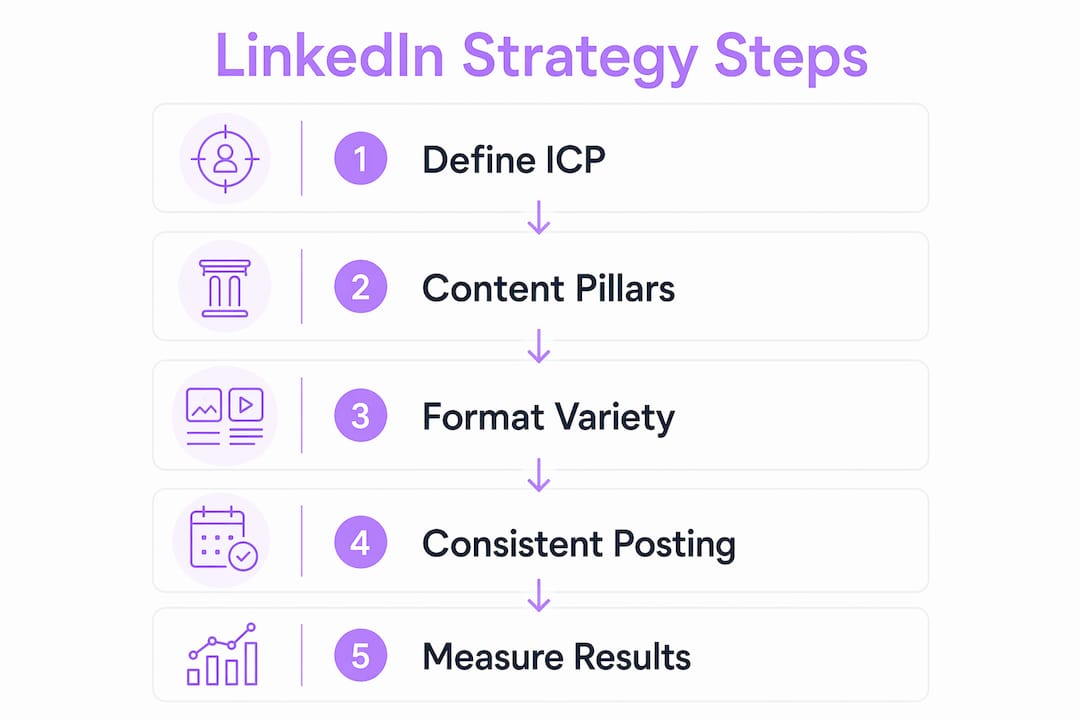
A LinkedIn content strategy is a documented, repeatable plan that defines your audience, content themes, posting frequency, and goals to grow your brand visibility on the platform. Without one, you are posting randomly and hoping for the best. The LinkedIn algorithm in 2026 rewards depth, consistency, and engagement quality over volume. A posting cadence of 3–5 times weekly produces the most reliable inbound results, with compounding effects typically visible after around 12 weeks. Pair that cadence with a 70-20-10 content mix and a clearly defined ideal customer profile, and you have the foundation of a plan that actually works.
What does a strong LinkedIn content strategy look like?
A strong LinkedIn content strategy starts with knowing exactly who you are talking to. Most marketing professionals and business owners make the mistake of defining their audience by job title alone. Job titles tell you what someone does. They do not tell you what problems keep them up at night, what decisions they are trying to make, or what content they will stop scrolling to read.
Build an ideal customer profile (ICP) around problems, goals, and buying triggers rather than demographics. For a Welsh professional services firm, that might mean targeting operations directors in mid-sized manufacturing businesses who are struggling to justify digital investment to their boards. That level of specificity changes everything about how you write.

Topical consistency and a narrow focus help the LinkedIn algorithm confidently route your content to the right audience. The algorithm builds a “topic DNA” for your profile over time. If you post about branding one week, recruitment the next, and leadership the week after, the algorithm cannot categorise you. Your reach suffers as a result.
Pro Tip: Use LinkedIn Analytics to check which posts attract profile visits from people inside your ICP. Those posts reveal the topics and formats your ideal audience actually responds to.
How do content pillars and formats drive LinkedIn engagement?
Content pillars are the three or four recurring themes that anchor everything you post. They give your feed coherence and help your audience know what to expect from you. Four pillars that work well for B2B LinkedIn content are Authority (your expertise and opinions), Process (how you work or think), Proof (results, case studies, testimonials), and Connection (personal stories that build trust).
Format variety matters as much as pillar structure. The LinkedIn algorithm rewards content that generates dwell time, saves, and private shares. Different formats produce different engagement patterns.
| Format | Strength | Best use |
|---|---|---|
| Text posts | Fast to create, high personal reach | Opinion, short insights, questions |
| Document/carousel | Highest reach and engagement | Educational frameworks, step-by-step guides |
| Images | Visual stopping power | Data, quotes, behind-the-scenes |
| Video | Strong dwell time signal | Demonstrations, talking-head commentary |
Document and carousel posts generate approximately 30–39% more reach than average LinkedIn posts. That uplift comes from dwell time. When someone clicks through ten slides, the algorithm reads that as a quality signal and promotes the post further. Design carousels as educational modules with a clear learning outcome per slide, not as passive slideshows.
The 70-20-10 content mix keeps your feed balanced. Seventy percent of posts should educate or help your audience. Twenty percent should share your opinion or point of view. Ten percent can be promotional. Audiences disengage quickly when a feed tips too far toward self-promotion.
What is the optimal posting cadence and timing on LinkedIn?
Consistency beats frequency every time on LinkedIn. Posting fewer than three times a week leads to algorithmic deprioritisation, while posting more than five times dilutes your topical authority. Three to five posts per week is the range where quality and consistency coexist.
Timing shapes how much initial traction a post receives. The best days to post are Tuesday through Thursday, with Wednesday producing the highest engagement. Midweek posts gain 34% higher click-through rates compared to posts published on weekends or Monday mornings. The peak window is 8:00 AM to 12:00 PM local time, which aligns with when professionals check LinkedIn before and between meetings.
The first 60–90 minutes after publishing are critical. Posts that underperform in the first hour rarely recover. The algorithm uses early engagement quality, specifically saves and substantive comments, as the primary signal for wider distribution. A post with three thoughtful comments in the first hour outperforms one with twenty quick reactions.
-
Post between 8:00 AM and 10:00 AM on a Tuesday, Wednesday, or Thursday.
-
Stay active for the first 90 minutes. Reply to every comment promptly and with substance.
-
Avoid posting on Monday mornings or weekends unless your analytics show otherwise.
-
Batch your content in advance so you are never scrambling to post on the day.
-
Schedule posts using a native or approved scheduling tool to maintain consistency during busy periods.
Pro Tip: Never place external links directly inside the post body. Posting external links in the body reduces reach by roughly 60%. Put the link in the first comment instead and reference it in the post.
How do you build a workflow for consistent content creation?
The biggest reason marketing professionals and business owners stop posting is not a lack of ideas. It is a broken workflow. Ninety percent of creators quit within 12 weeks due to blank-page paralysis caused by trying to ideate and write at the same time.
Separate idea capture from post writing. Keep a running list of content ideas in a notes app or a tool like Notion. Add to it whenever a client asks a question, a conversation sparks a thought, or you read something that challenges your view. By the time you sit down to write, you have a backlog to draw from rather than a blank screen.
-
Set aside 60–90 minutes once a week for content creation. Treat it as a fixed appointment.
-
Pull five ideas from your backlog and write drafts for each.
-
Review and edit the drafts on a separate day with fresh eyes.
-
Schedule the week’s posts in advance so publishing is automatic.
-
Spend 15 minutes each morning engaging with comments on your posts and on posts from people in your ICP.
Engaging thoughtfully with comments boosts a post’s reach by approximately 30% and signals content quality to the algorithm. Avoid engagement bait such as “comment YES if you agree.” LinkedIn’s algorithm penalises posts that explicitly ask for engagement without providing value.
Pro Tip: Organic content from personal profiles appears in up to 31% of feeds, compared to only 2% for company pages. Post from your personal profile and link back to your company page rather than the other way around.
How do you measure whether your LinkedIn strategy is working?
Vanity metrics mislead. Likes and impressions feel good but rarely correlate with business results. The metrics that matter are saves, direct messages, qualified profile visits, and follower growth within your ICP.
Saves and direct messages correlate with real business interest and carry more algorithmic weight than likes or quick reactions. A post that generates five DMs from potential clients is worth more than one that collects 200 likes from people outside your audience.
-
Saves: Signals that someone found the content worth returning to. High saves indicate strong educational value.
-
Direct messages: The clearest indicator of genuine interest or buying intent.
-
Qualified profile visits: Check who is visiting your profile after each post. Are they inside your ICP?
-
Follower growth within ICP: Track whether new followers match your ideal customer profile, not just total follower count.
-
Comment quality: Substantive comments from relevant professionals outweigh volume.
Run a monthly review. Identify the two or three posts that performed best across these metrics and analyse what they had in common. Kill content types that consistently underperform. Double down on the pillars and formats that attract your ICP. A simple spreadsheet with post date, format, pillar, and key metrics is enough to spot patterns within four to six weeks.
Key takeaways
A LinkedIn content strategy built on a clear ICP, defined content pillars, consistent cadence, and quality-focused metrics produces compounding results within 12 weeks.
| Point | Details |
|---|---|
| Define your ICP precisely | Build your audience profile around problems and goals, not job titles alone. |
| Use the 70-20-10 mix | Seventy percent educational, twenty percent opinion, ten percent promotional prevents audience fatigue. |
| Post 3–5 times weekly | Fewer than three posts causes deprioritisation; more than five dilutes topical authority. |
| Prioritise saves and DMs | These metrics signal real business interest and carry more algorithmic weight than likes. |
| Separate ideation from writing | A weekly batching workflow prevents burnout and keeps posting consistent over 12 weeks. |
What I have learned about LinkedIn content after years of watching brands get it wrong
Most businesses approach LinkedIn the same way they approach a billboard. They broadcast. They talk about themselves, their awards, their services, and their team days out. Then they wonder why nobody engages.
The brands and founders I have seen grow genuine audiences on LinkedIn share one trait. They post as if they are writing to one specific person with one specific problem. Not a demographic. Not a sector. One person. That level of focus feels uncomfortable at first because it seems like you are excluding people. You are not. You are making your content findable by the right people.
I would also push back on the obsession with going viral. A post that reaches 50,000 people outside your ICP is worth less than a post that reaches 500 people inside it. I have seen Welsh business owners chase impressions for months and win zero clients. I have seen others post quietly to 800 followers and close three contracts in a quarter because every post spoke directly to their buyer.
Patience is non-negotiable. The compounding effect of a consistent LinkedIn plan does not show up in week two. It shows up in week ten or twelve, when the algorithm has learned your topic DNA and your audience has built enough trust to act. Stick with it.
— Luke
How Jarvisandco can support your brand on LinkedIn
Building a credible LinkedIn presence takes more than good writing. Your profile, your visual identity, and the consistency of your brand across every touchpoint all influence whether a potential client trusts you enough to reach out.
Jarvisandco is a creative design agency with over 15 years of experience helping businesses across Wales and the UK build brands that generate leads and grow their online presence. From branding and web design to social media and digital marketing, the team at Jarvisandco works with businesses at every stage. If you want your LinkedIn content backed by a brand that looks the part, get in touch and we will help you get there.
FAQ
How often should I post on LinkedIn for best results?
Post three to five times per week. Fewer than three posts per week leads to algorithmic deprioritisation, while more than five dilutes your topical authority.
What content format performs best on LinkedIn?
Document and carousel posts generate approximately 30–39% more reach than standard posts. Design them as educational modules with a clear outcome per slide to maximise dwell time and algorithmic reach.
Should I post from my personal profile or my company page?
Post from your personal profile. Personal profiles appear in up to 31% of feeds, compared to only 2% for company pages. Link back to your company page within your content where relevant.
How long does a LinkedIn content strategy take to show results?
Consistent results typically appear after around 12 weeks of regular posting. The algorithm needs time to learn your topic focus and route your content to the right audience.
What metrics should I track on LinkedIn?
Track saves, direct messages, qualified profile visits, and follower growth within your ideal customer profile. These metrics reflect genuine business interest far more accurately than likes or total impressions.