Content pillars are a few recurring themes your business posts about repeatedly, instead of scrambling for a new idea every week. If you run a small business, start by picking a few: audit recent posts, list the questions customers actually ask you, and name the patterns you already see. That's it. That's the strategy.
TL;DR:
- Most small businesses should focus on three to five content pillars, chosen through a quick audit of existing posts and customer questions, rather than creating new ideas.
- Effective pillars are themes that overlap expertise, customer needs, and revenue, with content that consistently engages and generates leads over six to eight weeks.
- Typical pillars for service businesses include education, proof, and behind-the-scenes content, while retail may focus on product, customer stories, and lifestyle themes.
- Implementing a rotation schedule and repurposing content across formats streamlines posting and maintains consistency without overloading the team.
- Measuring success involves tracking engagement, traffic, conversion rates, and cost per lead, with ongoing adjustments needed after about ninety days.
Table of Contents
- What are content pillars for small business, exactly?
- Why content pillars matter for small businesses
- How to choose your pillars fast (the 30-minute audit)
- Practical pillar examples and starter sets for common small-business types
- Turning pillars into a calendar: rotation and repurposing
- How to measure whether your pillars are actually working
- How Jarvis & Co applies content pillars in client work
- A realistic timetable and the mistakes that stall momentum
- Get help turning pillars into a working website and content system
- Sources
What are content pillars for small business, exactly?
Content pillars are the recurring strategic themes that everything you publish falls under. Think of them as the categories your business is always talking about, whether that's "how we work," "results we've delivered," or "questions clients ask us." Content pillars structure your content and stop you posting at random, which is the single biggest problem small business social accounts have.
People often confuse pillars with content buckets, but they're not the same thing. A pillar is a theme (say, "client transformations"). A bucket is the format you use to express it, such as a testimonial video, a before-and-after carousel, or a blog post. Buckets and pillars work together but aren't interchangeable — one is the "what you talk about," the other is the "how you package it."
Pillars also map to where a customer sits in their decision:
- Awareness pillar: educational content that answers a question before anyone knows your name.
- Consideration pillar: proof, comparisons, and behind-the-scenes content.
- Conversion pillar: offers, case studies, and direct calls to book or buy.
A hairdresser might run "hair care education," "client transformations," and "salon life." Each does a different job in the funnel, but none of them need reinventing every Monday morning.
Why content pillars matter for small businesses
Pillars solve the problem most small firms actually have: not a lack of ideas, but a lack of a system. Without one, you post whatever crosses your mind, measurement becomes impossible, and burnout follows fast.
Pillars fix three things at once:
- They stop random posting, because every idea has a home.
- They let you pick two or three channels and do them properly, rather than spreading thin across five.
- They give search engines and AI tools consistent, structured content to index and cite.
Small businesses that succeed digitally tend to focus on a few high-impact channels with consistent execution, rather than trying to be everywhere. Pillars make that consistency achievable because you're not starting from a blank page each time. Strategy comes first, tactics second.
Pro Tip: If you can't name your three pillars off the top of your head in under ten seconds, you don't have pillars yet. You have habits.
How to choose your pillars fast (the 30-minute audit)
You don't need a workshop or a strategy deck to find your pillars. They're usually already sitting in your inbox and your post history, waiting to be named.
- Pull your last 20 to 30 posts, emails, and customer messages. List them in a spreadsheet or on sticky notes, whichever is faster.
- Group them by theme, not by format. You're looking for repeated subjects, not repeated formats.
- Cross-reference against the overlap framework: for each theme, ask whether it sits where your expertise, your customer's actual need, and your revenue overlap. Content that hits all three is a genuine pillar; content that hits only one is probably noise.
- Pick three to start. Most small businesses are best served by three to five pillars, and starting with three keeps the workload sane.
- Test for six to eight weeks before adding a fourth. If a pillar consistently gets engagement or leads, keep it and consider a fifth. If it goes quiet, retire it rather than force it.
The audit method matters more than the outcome. Instead of inventing content from scratch, look at what you already do and the questions customers already ask — the clusters you find are your pillars waiting to be named, not invented.
Practical pillar examples and starter sets for common small-business types
You don't need to design pillars from a blank page. Most business types fall into recognisable patterns, and adapting a proven set beats staring at a whiteboard.
Service businesses (trades, clinics, consultants):
- Education (trust): "how it works" and "what to expect" content.
- Proof (authority): before-and-after work, reviews, results.
- Behind the scenes (connection): the team, the process, the day-to-day.
Retail and e-commerce:
- Product spotlight (offer): new stock, features, use cases.
- Customer stories (proof): reviews, unboxings, user-generated content.
- Lifestyle content (connection): how products fit into a customer's world.
Creative agencies and freelancers:
- Case studies (authority): the problem, the process, the result.
- Process and tips (trust): sharing how you think, not just what you deliver.
- Client wins (proof): testimonials and measurable outcomes.
Social platforms commonly build pillar sets around storytelling, edutainment, product information, and community engagement, and each of those examples above maps neatly onto one of those categories. Pick the closest match, adapt the wording to your business, and you have a starting set by lunchtime.
Turning pillars into a calendar: rotation and repurposing
Pillars only earn their place once they're on a schedule. A rotation is simply deciding, in advance, which pillar shows up on which day, so you're never deciding what to post the morning you're meant to post it.
For regular posting, rotate through your pillars across the week; consistency matters more than exact posting volume or days. Either cadence works; consistency matters more than volume.
- Capture one core asset a week, a longer blog post, a case study, or a short video.
- Repurpose it into three formats: a blog excerpt, a short-form video clip, and a static image post. One long-form asset split into several social formats is a genuine efficiency gain for teams without a dedicated content person.
- Schedule the derived pieces across the week using a scheduler, so nothing relies on remembering to post live.
- Engage for fifteen to twenty minutes daily, replying to comments and messages on whatever's live that day.
A content calendar built around this kind of rotation removes the daily "what do I post" decision entirely, and if social specifically is your bottleneck, a structured social media content calendar does the same job for that channel alone.
How to measure whether your pillars are actually working
Pillars are only useful if you can tell which ones earn their place. Track four numbers, no more:
- Engagement (likes, comments, shares) per pillar, not per post, so you spot patterns rather than one-off spikes.
- Traffic from pillar content to your site, tagged with UTM parameters so you know which theme sent the visit.
- Conversion rate on the landing pages each pillar points to.
- Cost per lead, if you're running any paid promotion behind pillar content.
Strategy should come before tactics, and content needs to tie back to measurable outcomes rather than vanity metrics like follower counts. Set a monthly reporting cadence: if a pillar shows flat engagement and zero traffic after two reporting cycles, that's your signal to rework or retire it, not to post about it more often.
How Jarvis & Co applies content pillars in client work
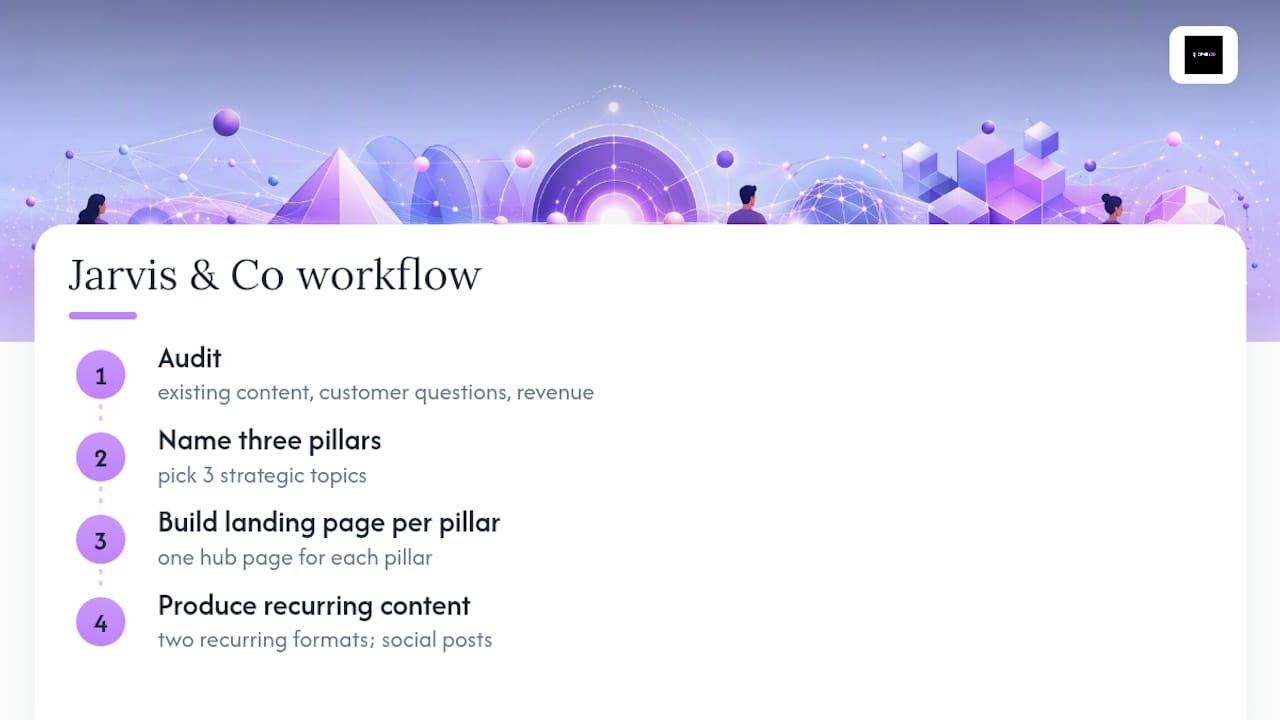
When Jarvisandco works with a client on branding or a new website, the process usually starts with the same audit described above: what's already been said, what customers keep asking, where the revenue actually sits. From there, each pillar gets mapped to one landing page or hub on the site and two recurring content formats. Mapping a pillar to a dedicated page rather than scattering it across posts alone improves both structure and search visibility.
A typical workflow looks like: audit → name three pillars → build one landing page per pillar → produce a matching social content set. It's a repeatable structure that a small in-house team, or a design agency working alongside one, can sustain without adding headcount.
A realistic timetable and the mistakes that stall momentum
Three months is a fair timeline to expect initial traction from a pillar strategy, not three weeks. Anything faster is luck, not method.
The mistakes I see most often: businesses choosing six or seven pillars because everything feels important, then abandoning half of them by month two. Others tip every post into a sales pitch, which drains engagement fast. And plenty never check a single metric, so they can't tell a working pillar from a dead one.
Pick three pillars this week. Put them on next month's calendar. Measure in ninety days.
— Luke
Get help turning pillars into a working website and content system
Auditing your posts and naming three pillars is the easy part. Turning them into landing pages, a content calendar, and social assets that actually convert takes ongoing hands, which is where most small teams stall. A creative design agency works alongside small businesses to take that audit and build the structure around it, rather than leaving you to translate a strategy document into actual pages and posts on your own.

The approach mirrors the framework above: we run the audit, help you settle on three to five pillars, then design a dedicated website with a landing page per pillar so your SEO and conversions have somewhere solid to point. If your brand identity needs sharpening before any of that content goes live, our logo design service can run alongside the same project. Get in touch to talk through your pillars and what a done-for-you calendar could look like for your business.
Sources
- What are Content Pillars and Why are They Important?
- A guide to social media content pillars
- Pillar content strategy for small business
- Content pillars for small businesses