Building an ecommerce website in the UK costs anywhere from a low first-year cost for a self-managed hosted store, to several thousands for a small-to-medium agency build, and significantly more for a large or enterprise project with custom integrations. GoDaddy's UK cost guide puts the first-year DIY total at roughly £203, a small-to-medium designer build at £7,137+, and a large ecommerce site at £11,270+. Those figures are a useful anchor, but they shift quickly once you add apps, photography, SEO setup, and payment processing. Here is what each band actually includes:
-
DIY/hosted (£203–£1,000 first year): A platform like Shopify or a GoDaddy Online Store plan, a free or low-cost template, a domain, and basic payment processing via Stripe or PayPal. You do most of the setup yourself.
-
Small-to-medium agency build (£7,137–£15,000): A custom or heavily customised template, professional design, WooCommerce or Shopify development, basic SEO setup, and a handover. Ongoing costs add £100–£500/month.
-
Large/enterprise (£11,270–£50,000+): Bespoke design, custom development, ERP or PIM integrations, advanced checkout logic, accessibility work, and a formal support retainer.
Vendor pricing changes regularly, so treat every figure here as a planning guide and re-check live rates before signing anything off.
Table of Contents
- Where does the money actually go?
- Which platform suits your UK store and budget?
- How much do design and development cost in the UK?
- Payment processing, VAT, and other UK business costs
- Hidden and recurring costs most owners forget
- How long does an ecommerce project take?
- How to budget and choose the right route
- Real project budgets from Jarvis & Co
- Quick price reference: what to expect at each budget level
- Key takeaways
- The honest truth about ecommerce pricing in the UK
- Jarvisandco builds ecommerce websites that actually work
- Useful sources and references
Where does the money actually go?
Understanding the line items behind a headline quote is what separates a good brief from a nasty surprise. Here is how a typical UK ecommerce budget breaks down.
Domain name
A UK domain (.co.uk or .com) costs roughly £10–£30 per year, with renewal at a similar rate. Some platforms bundle the first year free. Budget £20/year as a safe default.

Hosting and platform fees
This is where the DIY vs agency split becomes most visible. Hosted SaaS plans (Shopify, Squarespace, GoDaddy Online Store) charge a monthly fee that covers hosting, security patches, and uptime. Entry plans start at roughly £6.99–£16.99/month for basic stores. Self-hosted WordPress with WooCommerce needs separate hosting, which typically runs £5–£50/month depending on traffic and the provider.
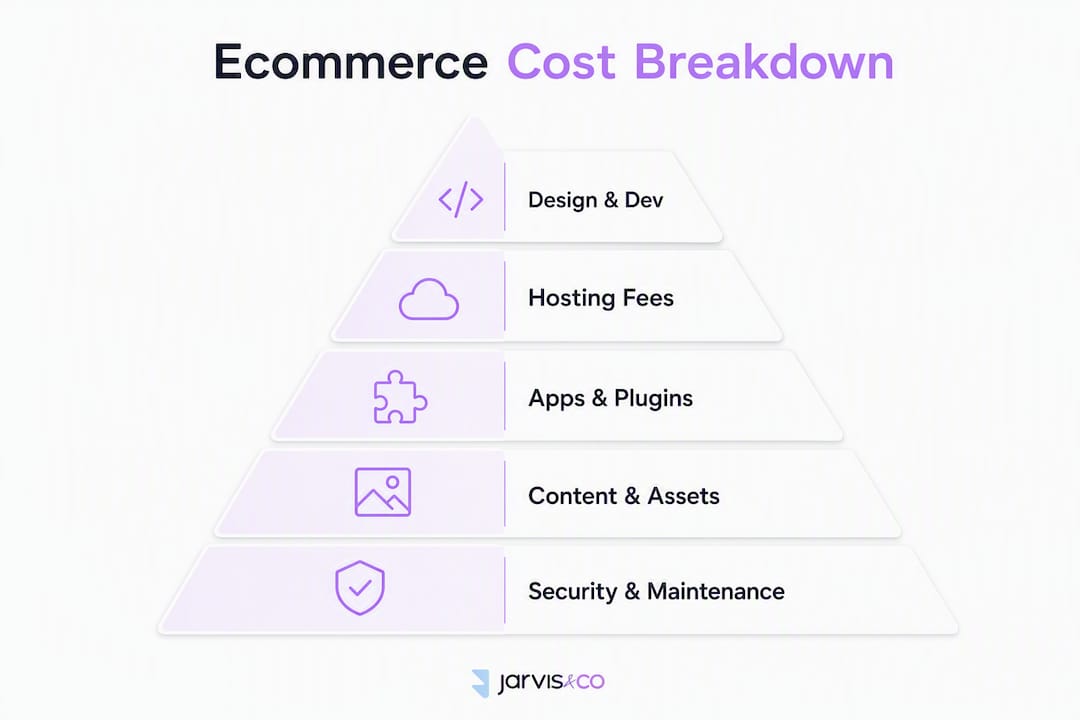
Design and development
Template customisation for a small store sits in the £500–£3,000 range. A freelancer building a mid-size Shopify or WooCommerce store typically charges £2,000–£8,000. An agency project with discovery, UX design, responsive build, and QA testing starts around £5,000 and climbs steeply with complexity.

Apps, plugins, and integrations
Most stores need at least a handful of paid add-ons: review tools, shipping calculators, abandoned cart recovery, advanced search, or subscription billing. Budget £30–£200/month for a growing store's app stack. ERP or POS integrations are one-off development costs that can add £2,000–£10,000+ to a project.
Content and assets
Product copywriting and product photography are frequently underestimated. A professional product photography shoot for a small catalogue runs £300–£1,500 in the UK. Copywriting for 50 product pages at a typical freelance rate adds another £500–£2,000.
SSL certificates
Many hosts include a basic SSL certificate free. Higher-assurance options (EV or OV certificates) can cost £100–£480+ per year according to GoDaddy's UK examples. For most SME stores, a free Let's Encrypt or host-bundled SSL is perfectly adequate.
Security, backups, and maintenance
Expect to pay £50–£300/month for a managed maintenance retainer covering updates, backups, uptime monitoring, and minor fixes. Some agencies offer annual plans at a discount. Skipping this entirely is the most common false economy in ecommerce.
Initial SEO and marketing setup
Technical SEO, product page templates, Google Analytics 4 configuration, and Google Search Console setup are commonly budgeted separately. Scope varies widely, but a realistic starting budget for a new UK store is a few hundred to a few thousand pounds depending on catalogue size and competition.
| Line item | Typical UK cost | Notes |
|---|---|---|
| Domain name | £10–£30/year | Renewal similar; first year sometimes free |
| Hosting (SaaS) | — | Entry hosted plans; scales with traffic |
| Hosting (self-hosted) | — | Shared to managed VPS |
| SSL certificate | Free–£480/year | Basic SSL often included |
| Template / theme | £0–£350 one-off | Free themes available on most platforms |
| Design and development | £500–£50,000+ | Widest variable; see Section 4 |
| Apps and plugins | £30–£200/month | Grows with feature requirements |
| Photography | £300–£1,500 per shoot | Per-day rates vary by region |
| Copywriting | £500–£2,000 | Depends on catalogue size |
| Maintenance retainer | £50–£300/month | Covers updates, backups, minor fixes |
| SEO and marketing setup | £300–£5,000 one-off | Technical SEO, GA4, Search Console |
Which platform suits your UK store and budget?
Platform choice is the single biggest cost lever after design. Get this wrong and you either overpay for features you do not need, or you hit a ceiling the moment your catalogue grows.
Hosted SaaS platforms (Shopify, BigCommerce, Squarespace) handle hosting, security, and software updates for you. You pay a monthly subscription and stay within the platform's ecosystem. Shopify is the dominant choice for UK SMEs wanting a reliable, well-supported platform with a large app marketplace. Squarespace suits smaller catalogues where design matters more than deep ecommerce functionality. GoDaddy's Online Store plans are a low-cost entry point for very simple stores, with plans starting around £6.99/month.
Self-hosted WordPress with WooCommerce gives you complete control over design, data, and functionality. There are no platform transaction fees, and the plugin ecosystem is vast. The trade-off is that you own the maintenance burden: updates, security patches, and hosting management fall to you or your developer. For stores with complex product structures, subscriptions, or bespoke checkout flows, WooCommerce often works out cheaper long-term than a SaaS platform's enterprise tier.
| Hosted SaaS (Shopify, Squarespace) | Self-hosted (WooCommerce) | GoDaddy Online Store | |
|---|---|---|---|
| Typical upfront cost | £0–£500 (template) | £500–£2,000 (setup + theme) | £0–£200 |
| Monthly/ongoing cost | £25–£250/month | £10–£80/month (hosting + plugins) | £6.99–£16.99/month |
| Best for | 10–5,000 products, growth-stage stores | Complex catalogues, custom logic | Under 100 products, starter stores |
| Ease of use | High; managed updates | Medium; requires technical upkeep | High; beginner-friendly |
| Scalability | Good; enterprise tiers available | Excellent; no platform ceiling | Limited; basic feature set |
| Transaction fees | 0.5–2% (Shopify Payments waives these) | None beyond payment gateway | None beyond payment gateway |
One thing many buyers miss: hosted platforms look cheaper upfront, but third-party apps can push monthly costs well above a self-hosted equivalent. A Shopify store with five paid apps at £30–£50 each quickly reaches £150–£250/month in subscriptions alone, before the platform fee. Factor that in before committing.
Pro Tip: If you are on Shopify and use Shopify Payments (powered by Stripe in the UK), the platform transaction fee drops to zero. Switch to a third-party gateway and you pay an additional 0.5–2% per transaction on top of the gateway's own fee.
How much do design and development cost in the UK?
The delivery model you choose (template, freelancer, or agency) affects both price and outcome more than almost any other decision.
Template customisation
Buying a premium theme on Shopify or WooCommerce (typically £50–£350) and customising it yourself or with a junior developer is the fastest route to a live store. Expect to pay a developer £500–£2,000 for colour, font, layout, and basic functionality tweaks. The result looks professional but shares its bones with thousands of other stores.
Freelance builds
A UK freelancer building a Shopify or WooCommerce store from a template typically charges £2,000–£8,000 for a small-to-medium project. UK freelancer rates run roughly £20–£50/hour for independent designers and £50–£150/hour for experienced agency-level freelancers. At 40 hours of work, that is £800–£6,000 in labour alone, before any platform or theme costs.
Agency builds
A specialist ecommerce agency charges £5,000–£15,000 for a well-scoped small-to-medium project and £15,000–£50,000+ for a large build with custom design, integrations, and QA. You get a structured process: discovery, wireframes, design sign-off, development sprints, and a formal handover. That structure costs money, but it also reduces the risk of scope creep and missed requirements.
When bespoke design pays off
Template builds are fine for stores under 200 products with standard checkout flows. Once you need a custom product configurator, subscription billing, trade pricing tiers, or a checkout that integrates with your ERP, bespoke development is not a luxury. It is the only way to build it correctly. Custom integrations typically add £2,000–£10,000+ to a project, depending on the complexity of the API and the quality of the third-party system's documentation.
Scope creep is the biggest budget risk in any ecommerce project. Agree a detailed specification before work starts, use milestone-based payments, and insist on a formal change-control process for anything outside the original brief. A vague "we'll sort the details as we go" approach from an agency or freelancer is a warning sign, not flexibility.
Payment processing, VAT, and other UK business costs
Payment fees are a running cost that most business owners underestimate at the planning stage. They do not show up in a build quote, but they affect your margin on every single sale.
Stripe vs PayPal in the UK
Both Stripe and PayPal are widely used by UK merchants and both integrate natively with Shopify and WooCommerce.
- Stripe charges a standard rate for UK cards and a higher rate for European and international cards, plus a small fixed amount per transaction. Rates vary by volume and card type. Stripe's dashboard and developer tools are generally considered cleaner and more flexible for custom checkout flows.
- PayPal offers a familiar checkout experience that some customers prefer, particularly for guest purchases. Its standard transaction fees are broadly comparable to Stripe's, though its dispute resolution process is often cited as more complex for merchants.
Using both gives customers a choice and can reduce cart abandonment. The cost of running both is minimal since neither charges a monthly fee on standard accounts.
VAT considerations
If your store turns over more than £90,000 per year, you must register for VAT. Once registered, you charge VAT on applicable goods, collect it, and pay it to HMRC. Your ecommerce platform needs to handle VAT correctly at checkout, including different rates for different product categories. Getting this wrong creates compliance risk. Speak to an accountant before launch if you are near the threshold or selling across multiple product categories with different VAT rates. This is general information, not tax advice.
Currency conversion and international selling
Selling internationally adds foreign exchange costs. Most payment gateways charge a currency conversion fee on top of the standard transaction rate. Multi-currency accounts (such as those offered by Wise or Airwallex) can reduce these costs for high-volume international sellers. Factor in conversion fees when pricing for overseas markets.
Chargebacks and refunds
Chargebacks cost more than the refunded amount. Most gateways charge a fee per chargeback dispute (typically £10–£20 per case), and losing a dispute means you absorb both the refund and the fee. A clear returns policy, good product descriptions, and accurate delivery estimates are the cheapest chargeback prevention tools available.
| Cost type | Typical UK range | Notes |
|---|---|---|
| Stripe standard UK card fee | Per-transaction rate + fixed amount | Varies by card type and volume; check Stripe's UK pricing page |
| PayPal standard fee | Per-transaction rate + fixed amount | Similar range; check PayPal's UK fee schedule |
| Currency conversion | Additional % per transaction | Varies by gateway and card issuer |
| Chargeback fee | £10–£20 per dispute | Applies win or lose in most cases |
| Merchant account monthly fee | £0–£30/month | Many gateways have no monthly fee on standard plans |
Hidden and recurring costs most owners forget
The build cost is a one-off. The running costs are forever. These are the ones that catch people out.
Routine maintenance
WordPress and WooCommerce sites need regular plugin and core updates. Skip them and you create security vulnerabilities. A managed maintenance retainer from an agency or developer typically costs £50–£300/month and covers updates, daily backups, uptime monitoring, and a small allowance for minor fixes. Shopify handles core updates automatically, but theme and app compatibility still needs checking after major releases.
App subscriptions
A typical growing Shopify store runs five to ten paid apps. Reviews, loyalty programmes, upsell tools, advanced shipping rules, subscription billing, and B2B pricing tiers all cost money monthly. It is easy to accumulate £150–£300/month in app fees without noticing. Audit your app stack every six months and remove anything you are not actively using.
Accessibility and legal compliance
WCAG 2.1 AA compliance is not legally mandated for all private sector websites in the UK right now, but the Equality Act 2010 creates real risk for businesses whose sites are inaccessible to disabled users. Remediating accessibility issues on an existing site can cost anywhere from a few hundred pounds for minor fixes to several thousand for a site that was never built with accessibility in mind. Building it in from the start is always cheaper. Budget for an accessibility audit (£300–£1,000) as part of your initial project.
Pro Tip: Ask your developer to run an automated WCAG audit using Axe or WAVE before launch. It catches the most common issues in minutes and costs nothing. Manual testing by a disabled user is more thorough but costs more — worth it for larger stores.
Hosting overages and traffic surges
Shared hosting plans have traffic limits. A viral product or a busy sale period can push you over them, triggering overage charges or, worse, downtime. A CDN (Content Delivery Network) like Cloudflare reduces load on your server and speeds up page delivery. Basic CDN plans are free; paid tiers with advanced features cost £15–£50/month. If you expect seasonal traffic spikes, discuss autoscaling options with your host before they happen.
Security monitoring and incident response
Malware removal on a compromised WooCommerce site costs £200–£1,000+ depending on severity. A security monitoring plugin or service (Wordfence, Sucuri) costs £5–£20/month and catches most threats before they become incidents. Cheap insurance.
How long does an ecommerce project take?
Timeline expectations are where client and agency relationships most often go wrong. Here is a realistic view.
- Discovery and scoping (1–2 weeks): Requirements gathering, competitor review, platform recommendation, and a detailed specification. Skipping this phase is the most reliable way to go over budget.
- Design (2–4 weeks): Wireframes, mood boards, homepage and key page designs, client review, and sign-off. Bespoke projects take longer; template projects can compress this phase.
- Development (3–8 weeks): Theme build or custom development, app integrations, payment gateway setup, and content population. The biggest variable in any timeline.
- Testing (1–2 weeks): Cross-browser and device testing, checkout flow testing, payment testing in sandbox mode, accessibility checks, and performance testing.
- Launch (1–3 days): DNS propagation, SSL confirmation, final checks, and go-live. Not a phase to rush.
- Post-launch optimisation (ongoing, first 90 days): Analytics review, conversion rate monitoring, SEO indexing checks, and bug fixes from real user behaviour.
| Project size | Typical timeline | Notes |
|---|---|---|
| Small (under 50 products, template build) | 4–6 weeks | Assumes content supplied by client |
| Medium (50–500 products, custom design) | 8 weeks | Includes discovery and design phases |
| Large (500+ products, integrations, bespoke) | 3–6+ months | ERP/PIM integrations add significant time |
In the first 90 days after launch, monitor these specifically: organic search indexing in Google Search Console, checkout abandonment rate, page load speed on mobile, 404 errors from any redirects, and your payment gateway's decline rate. Most post-launch issues surface within the first two weeks of real traffic.
How to budget and choose the right route
Before you request a single quote, get clear on these questions. They will save you time and protect your budget.
Budgeting checklist
- What is your total first-year budget, including ongoing costs, not just the build?
- Which costs are fixed (domain, hosting, platform fee) and which are variable (apps, marketing, photography)?
- Have you added a 15–25% contingency for scope changes, delays, and unexpected integrations?
- What is your expected ROI timeframe? A £10,000 site that generates £5,000/month in new revenue pays back in two months. A £10,000 site for a low-margin product with thin traffic does not.
Questions to ask agencies and freelancers
- Who owns the code, design files, and domain at the end of the project?
- Where will the site be hosted, and who controls the hosting account?
- What happens if I want to move to a different agency after launch?
- How are change requests handled and priced?
- What does your handover include — documentation, training, a support period?
- Can I speak to a previous client with a similar project?
Red flags to watch for
- A quote with no detailed specification attached.
- Hourly billing with no cap or estimate of total hours.
- No milestone payments — only a large deposit and a final payment.
- Reluctance to provide references or case studies.
- A proposal that promises everything in the brief with no pushback or trade-offs.
MVP first, features later
Launch with the features your customers need to buy from you. Add subscription billing, loyalty programmes, and advanced filtering after you have real sales data to justify them. Every feature added before launch extends the timeline and increases the budget. A live store generating revenue is always more valuable than a perfect store still in development.
Real project budgets from Jarvis & Co
These are anonymised examples based on the types of projects Jarvisandco handles for UK SMEs. Line items reflect actual scope decisions.
Small starter store
A sole trader selling handmade homeware, moving from Etsy to a standalone Shopify store.
| Line item | Cost |
|---|---|
| Domain name | £15 |
| Theme customisation and setup | £1,500 |
| Product photography (30 products) | £500 |
| Product copywriting (30 pages) | £400 |
| Basic SEO setup and GA4 | £350 |
Ongoing: Shopify plan + apps + maintenance, approximately £80–£120/month.
Growing SME store
A regional clothing retailer with 300 SKUs, needing a custom WooCommerce build with size guides, a returns portal, and Mailchimp integration.
| Line item | Cost |
|---|---|
| Discovery and specification | £800 |
| UX design and responsive build | £5,000 |
| WooCommerce development and integrations | £3,000 |
| Hosting (managed WordPress, first year) | £480 |
| Photography (100 products, 2 days) | £1,500 |
| Copywriting and content | £900 |
| SEO setup and technical audit | £800 |
| Accessibility review and fixes | £500 |
Ongoing: hosting, maintenance retainer, and apps, approximately £250–£400/month.
Larger multi-integration project
A B2B trade supplier with 1,500+ products needing a WooCommerce build with trade pricing tiers, ERP sync, and a custom quote-request checkout.
| Line item | Cost |
|---|---|
| Discovery, scoping, and UX | £2,000–£8,000 |
| Bespoke design (desktop and mobile) | £6,000 |
| WooCommerce development | £8,000 |
| ERP integration (custom API) | £7,000 |
| Trade pricing and quote checkout | £3,000 |
| Product data migration (1,500 SKUs) | £2,000 |
| SEO setup and content templates | £1,500 |
| Accessibility audit and remediation | £1,500 |
Ongoing: managed hosting, support retainer, and security monitoring, approximately £600–£900/month.
The biggest cost driver in every project is scope clarity. When a client arrives with a detailed brief — product count, integrations needed, design references, and a realistic timeline — we can price accurately and deliver on time. When the brief is vague, the budget grows. Every pound spent on a good discovery phase saves three in development.
[Jarvisandco invites you to view case studies and client work at jarvisandco.co.uk. For specific author credentials and biography, see the agency's about page.]
Quick price reference: what to expect at each budget level
| Budget band | Typical first-year cost | Best for | Recommended next step |
|---|---|---|---|
| DIY/hosted | £203–£1,000 | Sole traders, under 50 products, testing a concept | Start with Shopify or GoDaddy Online Store; upgrade when revenue justifies it |
| Small agency build | £7,137–£15,000 | SMEs with 50–500 products, needing professional design and basic integrations | Brief a specialist agency with a clear spec; ask for milestone-based pricing |
| Large/enterprise | £11,270–£50,000+ | Complex catalogues, ERP integrations, trade portals, high-volume stores | Commission a full discovery phase before committing to a build budget |
Integrations and custom functionality are the main cost multipliers at every level. A straightforward store at any budget band costs less than one with bespoke checkout logic, third-party API connections, or a large product migration. Use these bands as a starting point and refine with a detailed brief.
Key takeaways
Building a successful UK ecommerce website requires matching your platform, design approach, and budget to your actual product complexity and growth stage, with a 15–25% contingency built in from the start.
| Point | Details |
|---|---|
| Budget bands vary widely | DIY stores start at £203 first year; agency builds run £7,137–£50,000+ depending on complexity. |
| Ongoing costs matter as much as build cost | Apps, maintenance, hosting, and payment fees can add £80–£900/month depending on store size. |
| Platform choice drives long-term cost | Shopify suits growth-stage SMEs; WooCommerce suits complex or high-volume stores needing full control. |
| Contingency is not optional | Add 15–25% to any initial budget for scope changes, integrations, and post-launch fixes. |
| Jarvisandco for UK ecommerce builds | Jarvisandco handles Shopify and WooCommerce builds, photography, SEO, and ongoing support for UK SMEs. |
The honest truth about ecommerce pricing in the UK
Most business owners come to us having seen a quote they do not understand, or having built something themselves that is not converting. Both situations are avoidable with better information upfront.
The thing people consistently underestimate is not the build cost. It is the running cost. A £3,000 Shopify store with £200/month in apps, a £100/month maintenance retainer, and £50/month in payment fees costs £4,200 in year one and £4,200 every year after that, before you spend a penny on marketing. That is not a criticism of Shopify. It is just the reality of running a proper online store, and it applies to every platform.
What I see less often discussed is the cost of a bad brief. Vague requirements are the single biggest driver of budget overruns in ecommerce projects. A client who arrives with a clear product count, a list of required integrations, a realistic timeline, and a sense of what success looks like will always get a better price and a better result than one who says "we'll figure it out as we go." The discovery phase exists to create that clarity, and it is worth every penny.
Transparency in pricing is something Jarvisandco takes seriously. We give clients a detailed breakdown before any work starts, milestone payments tied to deliverables, and a clear handover at the end. If you want to see how that looks in practice, the case studies on the website show real project structures without the vague "from £X" language that makes budgeting impossible.
Jarvisandco builds ecommerce websites that actually work
Knowing the cost ranges is one thing. Getting a store that converts visitors into customers is another. Jarvisandco is a UK creative agency with over 15 years of experience building Shopify and WooCommerce stores for SMEs, trades, and specialist retailers across England. We handle everything from initial design and development to product photography, SEO setup, and ongoing support — so you are not stitching together five different suppliers and hoping it holds together.

Our pricing is transparent and milestone-based. You get a detailed spec before work starts, a fixed quote tied to agreed deliverables, and a proper handover with documentation and training. No open-ended hours, no surprise invoices. If you want to see anonymised project budgets before committing, we can walk you through examples on a discovery call.
Ready to get a clear quote for your ecommerce project? Request a quote or book a discovery call and we will get back to you promptly.
Useful sources and references
Vendor pricing changes regularly. Check live rates directly with each platform before finalising your budget.
- GoDaddy UK ecommerce cost guide (2026) — the primary UK source for headline cost bands, hosting, SSL, and developer hourly rates used throughout this guide
- GoDaddy UK website cost guide — broader UK website cost context including brochure sites and small business builds
- Hollis Web: how much does a website cost in the UK — useful reference for small brochure site costs and freelance rate context
- Shopify UK ecommerce cost guide — Shopify's own breakdown of platform costs and what to budget for a UK store
- Jarvisandco services page — for a quote or discovery call on your ecommerce project
- Jarvisandco: best web design agencies UK — context on how agency pricing differs across the UK
Reminder: platform subscription prices, app fees, and payment gateway rates are updated frequently by vendors. Always check the provider's current pricing page before committing to a budget. The figures in this guide reflect publicly available UK pricing at the time of writing and are intended as planning benchmarks only.