Strong property developer branding shortens sell-out time, supports higher achieved pricing, and builds a repeatable buyer pipeline for every scheme that follows. Get five things right first: a defined audience and proposition, a name with genuine purpose, a coherent visual identity, a website and digital presence that people can actually find, and a launch sequence that turns early interest into reservations. Track reservation percentages, enquiry quality, and time to sell, and you'll know within weeks whether the brand is working.
TL;DR:
- Establishing a clear brand identity before launch ensures faster sales, higher pricing, and a stronger pipeline by building trust and pre-qualifying buyers.
- Key assets like a dedicated website, virtual tour, and a high-quality brochure should be ready before taking any reservations to maximize early engagement.
- Consistent branding across touchpoints and involving one specialized partner reduces incoherence and maintains a coherent message through all development phases.
- Tracking reservation rates, enquiry quality, sale speed, and final prices helps measure the true impact of branding efforts on sales performance.
- Securing trademark protection, domain availability, and compliance with data and advertising standards prevent legal issues that could hinder marketing and reputation.
Table of Contents
- Why property developer branding matters for sales and pricing
- What are the core brand components of a property development?
- When should you introduce each brand asset before launch?
- How do you measure the commercial impact of developer branding?
- Why work with one specialist partner for developer branding?
- How does customer experience design strengthen developer branding?
- How can partnerships boost your developer brand's credibility?
- How do you scale a developer brand across multiple schemes?
- What legal issues should developers consider when branding a scheme?
- Lessons from the field
- How Jarvis & Co supports developer branding projects
- Sources
Why property developer branding matters for sales and pricing
Buyers commit hundreds of thousands of pounds to a property that doesn't exist yet, often from a set of CGIs and a hoarding board. That's an enormous trust gap, and branding is the tool that closes it. Edelman's research on brand trust shows trust strongly influences purchase decisions. In property, that translates directly into faster reservations and less resistance at pricing review.
A defined brand also filters who bother inquiring in the first place. A scheme with a vague identity attracts tyre-kickers who ask about parking and then vanish. A scheme with a clear proposition, "for young professionals who want a five-minute cycle to the station", pre-qualifies enquiries before your sales team picks up the phone.
Statistic Callout: Trust in a brand is a measurable driver of purchase behaviour, not a soft metric. Edelman's findings suggest developers who invest in credible brand infrastructure see that trust convert into commercial momentum, faster reservations, fewer price objections, and a smoother path to exit.
Branding also acts as a kind of pricing insurance. When a scheme has weak positioning, agents discount early to generate movement. When the brand has done its job, buyers arrive already convinced of the value, and that protects your asking price right through to the final units.
What are the core brand components of a property development?
Every development needs the same underlying architecture, whether it's twelve town houses or a 400-unit regeneration scheme. The scale changes; the components don't.
- Strategy first. Define the target buyer profile, the core proposition, and how this scheme relates to your wider developer brand (a "one badge for everything" approach versus a distinct identity per scheme).
- Naming with restraint. Resist naming the development before the narrative is settled. Delaying the name until you know what the scheme actually stands for avoids generic titles like "The Quarter" or "Riverside Gardens" that say nothing distinctive.
- Visual identity. A logo, a restrained colour palette, a consistent photography style, and clear direction for CGI artists so renders look like they belong to the same brand, not three different agencies' guesswork.
- Messaging. One sentence that says what the scheme is and who it's for, plus a tone of voice your sales team can actually use on the phone, not just in a brochure.
- Digital presence. A dedicated website, accurate property listings, a virtual tour, and the entity signals search engines rely on, Google Business Profile, structured data, and genuine reviews.
- Sales environment. The sales suite, printed brochures, and site signage all carrying the same identity, so a buyer who saw your Rightmove listing recognises the same brand when they walk through the showhome door.
Pro Tip: Build your digital entity signals, Google Business Profile, schema markup, and genuine reviews, before you spend heavily on visual polish. Practitioner guidance from the property sector is consistent on this: findability determines whether anyone sees your beautiful visuals at all.
A consistent brand system across every touchpoint is one of the clearest differentiators between developments that sell out quietly and those that stall at 60% and sit there for months.
When should you introduce each brand asset before launch?
Sequencing matters as much as the assets themselves. Introduce brand elements too early and you waste money refining a name before the proposition is settled. Introduce them too late and you launch to silence.
- Masterplan stage. Lock the strategy: buyer profile, proposition, and brand architecture. No visuals yet.
- Pre-launch (3 to 6 months out). Finalise naming, visual identity, and a landing page with hero imagery and a clear one-line proposition.
- Soft launch. Release a limited number of units to your database and local agents before going fully public. This tests pricing and messaging with lower stakes.
- Reservation event. Use the soft launch data to run a focused event or open weekend, backed by a brochure and virtual tour.
- Public launch and retargeting. Go wide with digital marketing, retargeting warm enquiries who didn't convert at soft launch.
- Phased release. Stagger remaining units to maintain scarcity and pricing momentum through to sell-out.
At minimum, secure a landing page, a high-quality brochure, and a virtual tour or CGI hero view before you take a single reservation. Those three assets consistently do the heaviest lifting for early sales.
How do you measure the commercial impact of developer branding?
Branding without measurement is just decoration. Set a baseline before launch, then track uplift against it.
- Reservation rate: reserved units at soft launch divided by units released at soft launch.
- Lead quality: your viewing-to-offer ratio, which tells you whether enquiries are pre-qualified or scattergun.
- Days to sell: logged per launch phase, so you can spot whether phase two moves faster than phase one.
- Price achieved versus asking: the clearest signal of whether the brand is protecting margin or forcing discounts.
A branded, content-rich site can multiply engagement compared with a generic template; one case study from Luxury Presence recorded 2.6 times the traffic and over a thousand leads after a rebrand and relaunch. Treat brand spend as an investment against acquisition cost, not a discretionary line item, and report on it monthly during launch, then quarterly once the scheme is trading steadily.
Why work with one specialist partner for developer branding?
Fragmented delivery, one agency for the logo, another for the website, a third for photography, is where most developer brands lose coherence. Jarvisandco has spent over 15 years building end-to-end brand and web identities, and the pattern holds across sectors as much as it does across property.
- The Level Up Fitness case study shows what a single partner delivering full brand identity and website build looks like in practice, from proposition through to launch.
- The Leigh & Co case study demonstrates consistency across web and sales collateral, the exact discipline a phased property launch demands.
One partner means one set of brand guidelines, one point of accountability, and no gap between what the website promises and what the sales suite delivers.
How does customer experience design strengthen developer branding?
Branding doesn't stop at the logo and the brochure. It shows up in how a buyer actually experiences your process, from the first click on a listing through to picking up keys. A polished website that leads to a confusing enquiry form, a slow response, or a sales suite that contradicts the digital imagery undoes the brand equity you just paid to build.
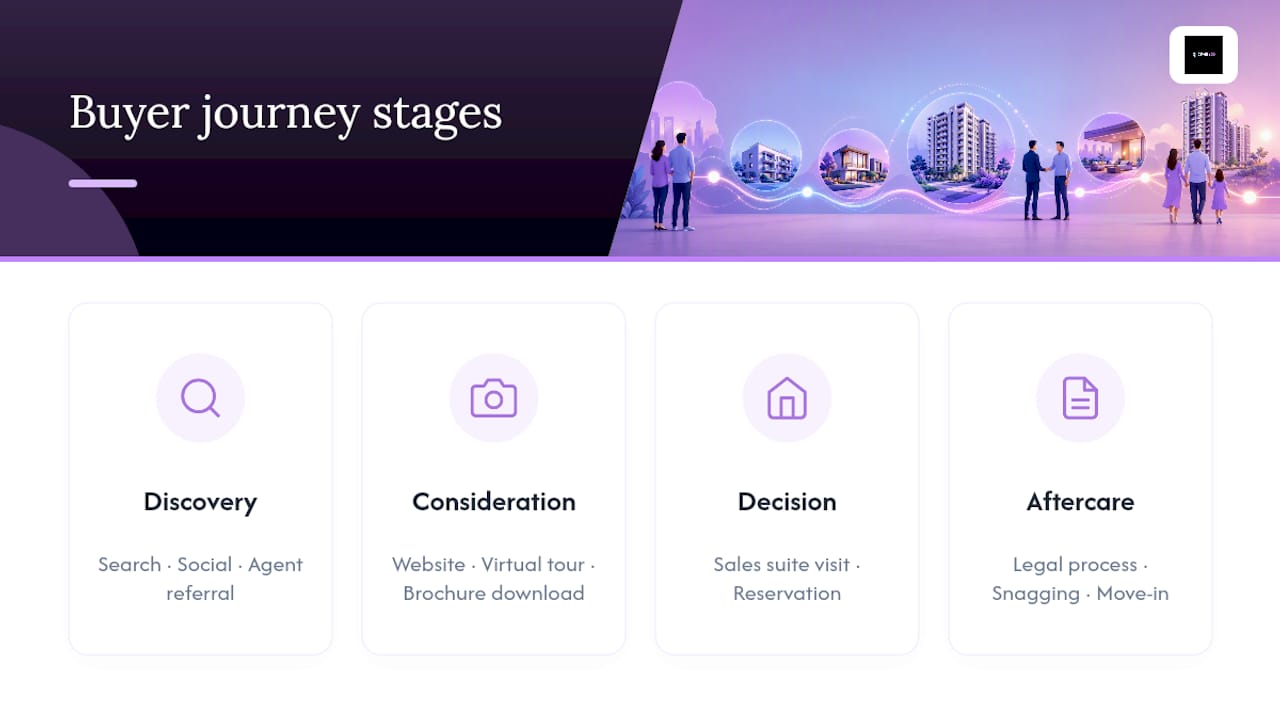
Map the buyer journey stage by stage: discovery (search, social, agent referral), consideration (website, virtual tour, brochure download), decision (sales suite visit, reservation), and aftercare (legal process, snagging, move-in). Each stage needs a brand-consistent experience, not just consistent visuals.
Google's research on web design found that people strongly favour simple, familiar layouts that create a fast, confident first impression. For a developer website, that means clear navigation to floor plans and pricing, not a cluttered homepage trying to say everything at once. A virtual tour built through Matterport extends that same experience beyond the site visit, letting buyers walk a home remotely and improving both accessibility and lead quality.
The developments that convert best treat every handoff, website to phone call, phone call to sales suite, sales suite to legal pack, as part of the same designed experience. Buyers notice friction even when they can't name it, and it shows up in your enquiry-to-reservation ratio.
How can partnerships boost your developer brand's credibility?
A new development has no track record. Third-party endorsement is how you borrow credibility while you build your own.
Local business partnerships work well here: a coffee roaster, a gym, or an independent retailer taking space in your ground-floor units gives buyers proof the development will feel like a real neighbourhood, not a construction site with a marketing budget. Naming these tenants in your brochure and on your website does more for credibility than another CGI render.

Trade endorsements matter too. Certifications from bodies like the NHBC, partnerships with recognised architects, or awards from regional property associations all signal that qualified people have scrutinised the scheme and approved of it. List them visibly on the website and in the sales suite, not buried in a PDF nobody opens.
Reviews and testimonials from earlier phases or previous developments carry particular weight for repeat developers. A buyer researching your latest scheme who finds genuine, verifiable feedback from residents of your last one is far more likely to trust the pitch. This only works with real, attributable feedback, fabricated or vague "our residents love it" claims are easy to spot and damage trust faster than having no testimonials at all.
Finally, media coverage and local press mentions, even modest ones in a regional property title, function as social proof that outperforms paid advertising on a pound-for-pound basis. Building a relationship with local journalists ahead of launch is worth the time it takes.
How do you scale a developer brand across multiple schemes?
The developers who benefit most from branding aren't necessarily doing one scheme brilliantly. They're doing several schemes consistently, and letting each one make the next one easier to sell.
A master developer brand, sitting above individual scheme names, reduces acquisition cost for every project that follows because buyers and agents already recognise and trust the name. That's a compounding return branding gets very little credit for: your third development shouldn't need the same marketing spend as your first, because the brand is doing part of the selling for you.
Deciding how to structure that architecture matters early. Some developers run every scheme under one visual identity with the development name as a subtitle ("[Developer Name] presents The Maltings"). Others give each scheme its own distinct brand while keeping a consistent "developed by" credit line. Neither approach is universally right, but pick one deliberately rather than drifting into inconsistency scheme by scheme.

Document your brand guidelines properly after the first project, logo usage, colour codes, photography style, tone of voice, so the second and third schemes don't require reinventing decisions you already made. Keep a scheme-specific layer (name, palette accent, local messaging) distinct from the master layer (logo, typography, core values) so you can evolve individual launches without diluting the parent brand.
Review the master brand every few schemes rather than every few months. Property branding needs consistency to build recognition, and constant tinkering undermines the very trust you're trying to accumulate.
What legal issues should developers consider when branding a scheme?
Trademark protection is the piece most developers overlook until a rival scheme uses a suspiciously similar name. Before committing to a development name or master brand, run a clearance search through the UK Intellectual Property Office to confirm nothing identical or confusingly similar already exists in the property or construction classes.
Registering a trademark for your development name, and separately for your developer brand if you plan to reuse it, protects you from a competitor launching a scheme with a near-identical name in the same region. It's a modest cost relative to the marketing spend you'll put behind that name over a multi-year sell-out period.
Domain and social handle availability should factor into naming decisions too. A name that's legally clear but has no available domain, or one already squatted by a reseller, creates friction you don't need during launch.
Data protection is the other area developers underestimate. Websites collecting enquiry details, virtual tour interactions, or newsletter sign-ups need proper consent mechanisms under UK GDPR. Cookie consent plugins are a practical, low-cost way to handle this correctly on a WordPress-built site, and getting it wrong risks both regulatory exposure and buyer distrust at exactly the moment you're trying to build credibility.
Advertising standards also apply to CGIs and renders. The ASA has taken action against developers whose marketing imagery misrepresented the finished product, so keep render disclaimers clear and proportionate to avoid disputes after handover.
Lessons from the field
The single mistake I see most often is developers naming the scheme before they've settled the strategy, then falling in love with that name and refusing to revisit it once the audience and proposition are clearer. Fix the strategy and digital findability first. Everything else follows more easily once those are settled.
The second recurring problem is running branding across three or four separate suppliers, a branding freelancer, a website developer, a photographer, with no one holding the whole picture together. The result is always visible in the final product: mismatched tone, inconsistent imagery, a sales suite that doesn't look like the website.
If budget is tight, prioritise three things only: a proposition-led landing page, a genuine virtual tour, and consistent signage from hoarding to sales suite. Skip everything else before you skip those.
— Luke
How Jarvis & Co supports developer branding projects
Jarvisandco works as a single partner for property developers who'd rather not manage four separate suppliers to get one coherent brand. That means branding, website design, photography, and sales collateral all delivered under one roof, with one team accountable for consistency from the hoarding board to the reservation form.
We start every developer project with a discovery session to pin down the buyer profile and proposition before a single visual is drawn, in line with the "strategy first" approach covered above. From there, scope typically covers logo and visual identity, a bespoke website with virtual tour integration, and printed brochures and signage that match the digital experience exactly. Most developer branding projects run to a phased timeline that mirrors your own launch sequence, so assets land when your sales team actually needs them, not weeks after soft launch has already started. Get in touch through Jarvisandco to scope your next scheme.
Sources
- Edelman Trust Barometer — special report on brand trust
- Real estate branding: the digital entity is the dominant layer — Jeff Lenney