
A logo alone typically runs £500 to £3,000. A brand starter pack (logo plus basic guidelines) sits at £1,500 to £5,000. A full brand identity, with strategy and a proper guideline document, lands between £5,000 and £20,000. A comprehensive rebrand with strategy and rollout across every channel generally involves a considerably larger investment, often significantly above mid-range figures.
Why such a wide spread? Scope, strategy input and agency size all move the number, sometimes by tens of thousands of pounds.
- Logo only: £500 to £3,000. Speak to a freelancer or a small studio.
- Starter pack: £1,500 to £5,000. A boutique studio usually fits best here.
- Full identity: £5,000 to £20,000. Look at an established boutique or a mid-size agency.
- Comprehensive rebrand: £10,000 to £50,000+. This needs an agency with strategy capability.
Quick figure to bank: most UK guidance in 2026 places a full identity project in the £5,000 to £20,000 bracket, with strategy work being the single biggest reason projects push toward the top of that range.
Key Takeaways
Branding cost in the UK depends far more on strategy scope and rollout requirements than on the logo design itself.
| Point | Details |
|---|---|
| Price bands vary widely | Logo only runs £500 to £3,000; full identity typically £5,000 to £20,000; comprehensive rebrands £10,000 to £50,000+. |
| Strategy drives cost more than design | Strategy-led projects with research and positioning work cost materially more than design-only jobs. |
| Rollout is the hidden extra | Printing, signage, and web builds sit outside the design fee and commonly double the apparent project cost. |
| Ownership must be confirmed in writing | Always request a one-line IP statement confirming full rights transfer on final payment. |
| Match provider to project scale | Jarvisandco offers starter logo packs through to full identity and website rollout combinations scoped to your brief. |
Table of Contents
- What drives branding agency rates UK-wide up or down?
- How much do UK branding services cost at each tier?
- What should be included in your branding package quote?
- Logo refresh or full rebrand: which do you actually need?
- How to budget and approve a branding project
- Freelancer, boutique studio or agency: how do you choose?
- How Jarvis & Co prices branding work for UK SMEs
- Does branding cost more in some UK sectors than others?
- What does branding cost after the rebrand launches?
- Do digital or traditional branding elements cost more?
- Why most branding budgets fail before the brief is even written
- Get a clear, tailored branding quote from Jarvisandco
- Sources
What drives branding agency rates UK-wide up or down?
The single biggest swing factor is whether you're paying for strategy or just design. A design-only job takes your existing positioning and gives it a new look. A strategy-led project starts by asking who you're actually trying to reach and why they'd choose you over a rival, then builds the visual identity to answer that question. That extra thinking, workshops, market research, sometimes customer interviews, is where costs climb fastest.

Deliverables matter just as much. A basic job might hand you a logo and two colour variations. A fuller brief adds brand architecture (how sub-brands or product lines relate to each other), a tone of voice guide, a proper guidelines document, templates for social and print, and sometimes commissioned photography. Each one adds hours.
Agency size changes the maths too. A solo freelancer has lower overheads and often lower rates, but limited capacity for big, multi-stakeholder projects. A larger studio or agency carries more process, more senior oversight, and a higher day rate to match.
Three more line items catch people out:
- Stakeholder count and revision rounds. Five decision-makers signing off means more rounds, more meetings, more cost.
- Rush fees. Compressing a ten-week timeline into four usually adds a premium.
- Rollout costs. Printing, signage, and website rebuilds sit outside the design fee and are the most commonly forgotten extra.
Pro Tip: Ask every quote to separate the design fee from the rollout estimate. Agencies that bundle them vaguely are usually hiding a much bigger number.
How much do UK branding services cost at each tier?
Pricing tends to cluster into four recognisable bands, and knowing which one matches your brief saves a lot of wasted back-and-forth with providers.
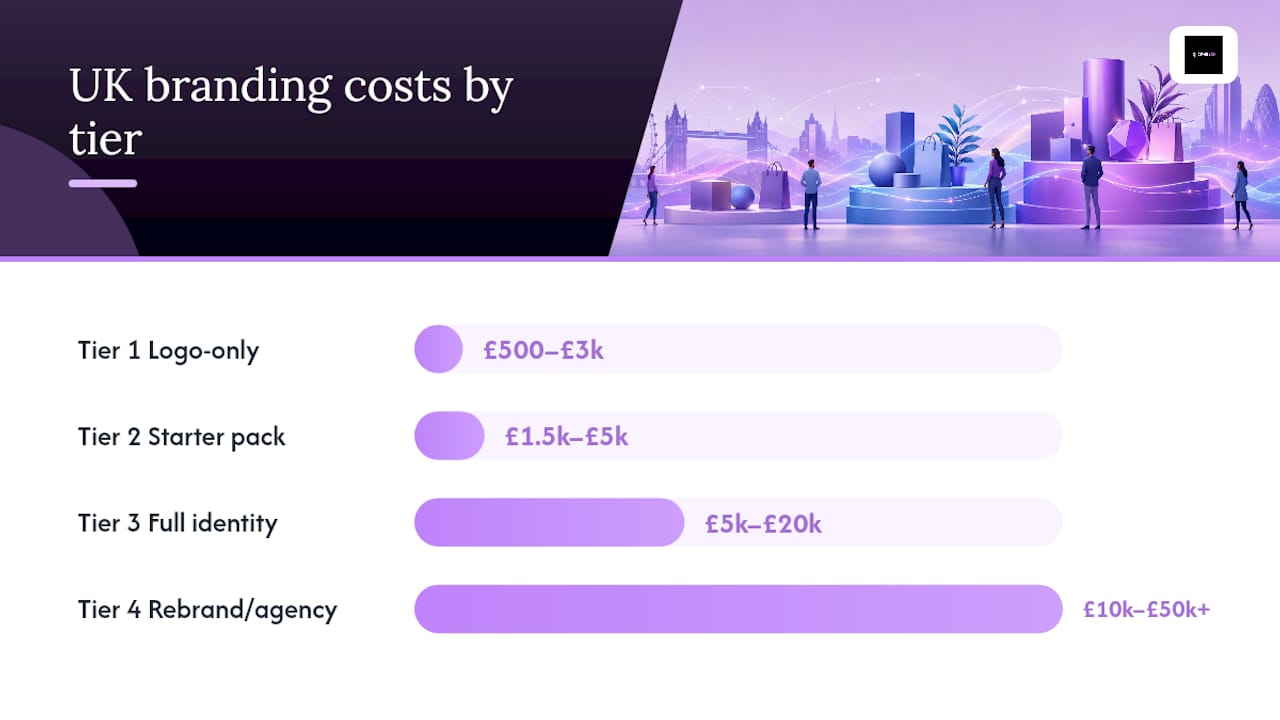
Tier 1: Logo only. Typically £500 to £3,000. You get a final logo file, perhaps two or three variations (horizontal, stacked, icon-only), and basic colour codes. Marketplace and print-service providers such as Vistaprint quote toward the lower end of this range, though those packages rarely include strategy or usage guidance.
Tier 2: Brand starter pack. Typically £1,500 to £5,000. This adds a short guidelines document (colours, fonts, logo dos-and-don'ts) plus a handful of templates, a letterhead, a social media kit, maybe a simple business card design.
Tier 3: Full brand identity. Typically £5,000 to £20,000. This is where strategy enters properly: positioning work, a complete visual identity system, a full guidelines document, and key templates across print and digital. Independent studio commentary consistently places this band from roughly £3,000 to £6,000 at the lower end, scaling toward £15,000+ once strategy and a wider deliverable set are included.
Tier 4: Comprehensive rebrand or agency programme. Typically £10,000 to £50,000 or more. This covers multi-stakeholder strategy work, a full identity system, and coordinated rollout across signage, packaging, web, and vehicle livery where relevant. It's the natural bracket for mergers, franchise rollouts, or a business repositioning after years of drift.
Timelines follow a similar pattern: a logo-only job might close in one to two weeks, a starter pack in three to four, a full identity in six to ten, and a comprehensive rebrand can run four to six months once rollout is factored in. Budget accordingly rather than assuming design work alone dictates your schedule.
What should be included in your branding package quote?
Before you sign anything, check the quote actually lists what you're paying for, not a vague promise of "branding."
- Vector master files (AI, EPS or SVG) so your logo scales cleanly from a business card to a billboard.
- Colour specifications in every format you'll need: CMYK for print, RGB and hex for digital.
- Font licences, confirming whether you own usage rights or need to purchase a separate licence for commercial use.
- Template files for the applications agreed in your brief, whether that's letterheads, social posts, or a PowerPoint deck.
- A written IP and usage statement, confirming the files are yours outright once final payment clears.
That last point trips up more SMEs than any other. "Source files" and "full rights" sound reassuring but mean nothing unless spelled out. Some freelancers retain rights to reuse elements of your design in their own portfolio or for other clients unless you agree otherwise in writing.
Before you approve any quote, confirm: number of revision rounds included, exact file formats you'll receive, delivery timetable, and what triggers an additional fee.
Pro Tip: Ask for one sentence in the proposal stating "all IP transfers to the client upon final payment." If an agency hesitates to add that line, treat it as a warning sign.
Logo refresh or full rebrand: which do you actually need?
A logo refresh tightens up an existing mark, perhaps modernising the typeface or simplifying an overly detailed icon, while keeping the brand recognisable to existing customers. A full rebrand rebuilds the identity from the ground up: new strategy, new visual system, sometimes a new name.
A refresh usually suffices when your positioning still works but the visuals feel dated, or you're launching one new product line under an existing umbrella. It's a design-only job in most cases, and it sits comfortably in the logo-only or starter pack bands.
A full rebrand becomes necessary after a merger, a genuine strategic repositioning, or when you're rolling out across multiple markets and channels simultaneously. That's strategy-led work, and it belongs in the full identity or comprehensive rebrand bands.
The cost gap between the two is stark:
- A refresh might cost £1,000 to £5,000 and take a few weeks.
- A full rebrand with rollout can run £15,000 to £50,000+ and take several months, with signage, packaging, and website costs often exceeding the design fee itself.
How to budget and approve a branding project
Set your ceiling before you request a single quote, not after.
- Set a percentage of marketing spend. Many SMEs allocate 10 to 20% of their annual marketing budget to a one-off rebrand year, then return to normal spend afterwards.
- Reserve a separate rollout budget. Add 30 to 50% on top of the design fee for print, signage, and web changes, since under-budgeting rollout is the most common mistake agencies report.
- Build in a contingency. A 10% buffer covers the inevitable extra revision round or last-minute print run.
- Write a brief that names your competitors, your audience, and your must-have deliverables. Vague briefs produce quotes that can't be compared fairly.
- Structure payments against milestones, not calendar dates. Deposit, strategy sign-off, design sign-off, final delivery.
Pro Tip: Send the identical brief to every provider you're quoting. If their quotes vary wildly, the difference usually lies in what's excluded, not what's included.
Watch for three red flags at proposal stage: no fixed deliverables list, pricing quoted purely by the hour with no cap, and reluctance to put revision limits in writing.
Freelancer, boutique studio or agency: how do you choose?
Match the provider to your project's complexity, not your budget alone. A single-founder business needing a logo refresh rarely needs a twelve-person agency. A retail chain repositioning across forty locations rarely gets what it needs from a solo freelancer working evenings.
Ask every provider the same set of questions before comparing quotes:
- How many stakeholders can your process comfortably handle?
- What happens if we need more revisions than the contract allows?
- Do we own the source files outright once we've paid in full?
- Can you show a project of similar scale and sector to ours?
- What's excluded from this quote that we might assume is included?
Red flags to watch for: opaque scope documents that don't list deliverables, insistence on hourly billing with no overall estimate, and reluctance to confirm ownership terms in writing.
To compare quotes fairly, line them up against the same five criteria: total deliverables, revision rounds, timeline, ownership terms, and rollout support. A directory search through the DBA can help you shortlist credentialed studios with relevant sector experience before you start requesting quotes.
How Jarvis & Co prices branding work for UK SMEs
Jarvisandco has spent over 15 years building brands, websites, and digital campaigns for UK small businesses, start-ups, trades, property developers, and healthcare clinics. Pricing gets built around your brief rather than a fixed rate card, but three package shapes come up repeatedly:
- Starter logo pack: for businesses needing a clean mark and basic guidelines before launch.
- Full brand identity: strategy, visual system, and templates for businesses repositioning or scaling.
- Website and brand rollout combined: identity work paired with a new site build, useful when a rebrand and a website redesign need to happen together rather than in sequence.
These are illustrative shapes, not fixed prices. If you want a tailored figure, the Jarvis & Co team will scope your brief directly.
Does branding cost more in some UK sectors than others?
Sector shapes price more than most business owners expect. A trades business (an electrician, a plumber, a small building firm) often needs a straightforward identity: a strong logo, van livery, and a simple website, which typically sits in the starter pack or lower full-identity band. Compliance and licensing pressures are minimal, so the design brief stays narrow.
Healthcare and aesthetic clinics sit higher up the scale. Trust signals matter enormously to patients choosing a clinic, so branding here often includes professional photography, a considered tone of voice, and website work that reflects clinical credibility. Full identity budgets for this sector regularly reach the top of the £5,000 to £20,000 band.

Property developers tend to need the most complex rollout: hoardings, signage across multiple sites, brochures, and a website that can showcase several developments at once. That pushes many developer rebrands into comprehensive territory, £15,000 upward, once print and signage are costed in.
Company size matters independently of sector. A sole trader or micro-business rarely needs brand architecture work covering multiple product lines. A business with fifteen staff and three service lines usually does, and that alone can add several thousand pounds regardless of which industry it sits in. ONS business data shows the vast majority of UK enterprises are small businesses with fewer than 50 employees, which is exactly why most branding budgets in this article cluster below the £20,000 mark rather than into agency-programme territory.
What does branding cost after the rebrand launches?
The invoice for the identity itself is rarely the last one you'll see. Most businesses need ongoing brand management once the new look is live, and skipping this line item is how a fresh identity slides back into inconsistency within eighteen months.
Typical ongoing costs include:
- Guideline updates. As your product range or service offer changes, your guidelines document needs revisiting, usually a few hundred pounds for minor updates.
- Template refreshes. New campaign formats, seasonal social assets, or an added service line all need new templates built against the existing system.
- Brand audits. An annual check that everything from your invoices to your van signage still matches the guidelines catches drift before it becomes expensive to fix.
- Asset library management. Someone needs to own the master files and issue them correctly to printers, web developers, and staff, whether that's an internal marketing hire or a retained studio relationship.
Businesses that budget a modest ongoing allowance, often a fraction of the original identity cost each year, tend to get far more longevity from their branding than those who treat the rebrand as a one-off spend and never revisit it.
Do digital or traditional branding elements cost more?
Digital assets have become the larger share of most branding budgets, and that shift changes where your money should go. A website, social media templates, email signatures, and digital ad formats all need to work together, and building that system properly, responsive layouts, multiple screen sizes, animated logo variants, adds real design hours beyond a static print identity.
Traditional elements, business cards, signage, vehicle livery, printed brochures, still carry cost, but it's often more predictable. A print design run has a fixed unit cost once the artwork exists. Digital rollout costs less in materials but more in design and development time, particularly if your rebrand includes a full website build rather than a template refresh.
For most SMEs, the practical split looks like this: budget more heavily toward digital asset development, since your website and social presence get seen far more often than a printed brochure, but don't strip the traditional budget entirely. Signage and print still matter for trades and retail businesses with physical premises. A website design that ties cleanly into your new identity is usually the single highest-value digital spend in a rebrand, because it's the asset most prospective customers will actually encounter first.
Why most branding budgets fail before the brief is even written
The conventional advice tells SMEs to "get three quotes and compare." That's incomplete advice, and it's why so many business owners end up comparing wildly different things and calling one of them expensive. Three quotes built from three different briefs aren't comparable at all. The real fix happens before you contact a single provider: write down your deliverables, your stakeholder count, and your rollout scope first, then send that identical brief to everyone you approach.
What's overrated in most guidance on this topic is the fixation on the headline number. A £4,000 quote that excludes ownership rights and rollout support can cost more in the long run than an £8,000 quote that includes both. What's underrated is asking about revision limits and IP terms before you ever discuss price, because those two items are where budgets quietly balloon three months after the invoice is paid.
If you take one thing from this guide, prioritise clarity over cheapness. A precise brief, matched to the right tier of provider, saves far more money than chasing the lowest number in your inbox.
*— Luke
Get a clear, tailored branding quote from Jarvisandco
Jarvisandco gives you one fixed-scope quote built around your actual brief, not a rate card that leaves rollout, ownership, and revisions as unpleasant surprises later. Where a freelancer might hand you a logo with no strategy, and a large agency might quote you for process you don't need, Jarvisandco scopes projects to match SME budgets while still covering strategy, guidelines, and rollout planning in one proposal.
Whether you're after a starter logo pack, a full identity system, or branding paired with a new website build, the team scopes the work against your brief before quoting, so you know exactly what you're paying for and what you'll own at the end of it. If you're ready to see what a tailored quote looks like for your business, get in touch through Jarvis & Co or explore the logo design service directly to start the conversation.
Sources
Consult ONS business data for SME statistics and the DBA directory to verify credentialed design studios.
- Branding Insights for Hospitality, Food and Lifestyle Brands
- How much does branding cost in the UK? Updated 2026
- Business and industry data | ONS