
A brand messaging framework is defined as a hierarchical system that connects your brand’s mission through positioning, value propositions, and proof points to the specific copy used across every channel. Without one, your marketing becomes a series of disconnected messages that confuse rather than convert. Messaging frameworks increase ad engagement by 15–25% and remove guesswork from creative production. That combination of consistency and speed is why businesses across Cheshire East and beyond treat a well-built framework as a core business asset, not a branding luxury.
What are the core components of a brand messaging framework?
A brand messaging framework is built in layers, and each layer serves a distinct purpose. The structure moves from the most stable elements at the top to the most flexible at the bottom.
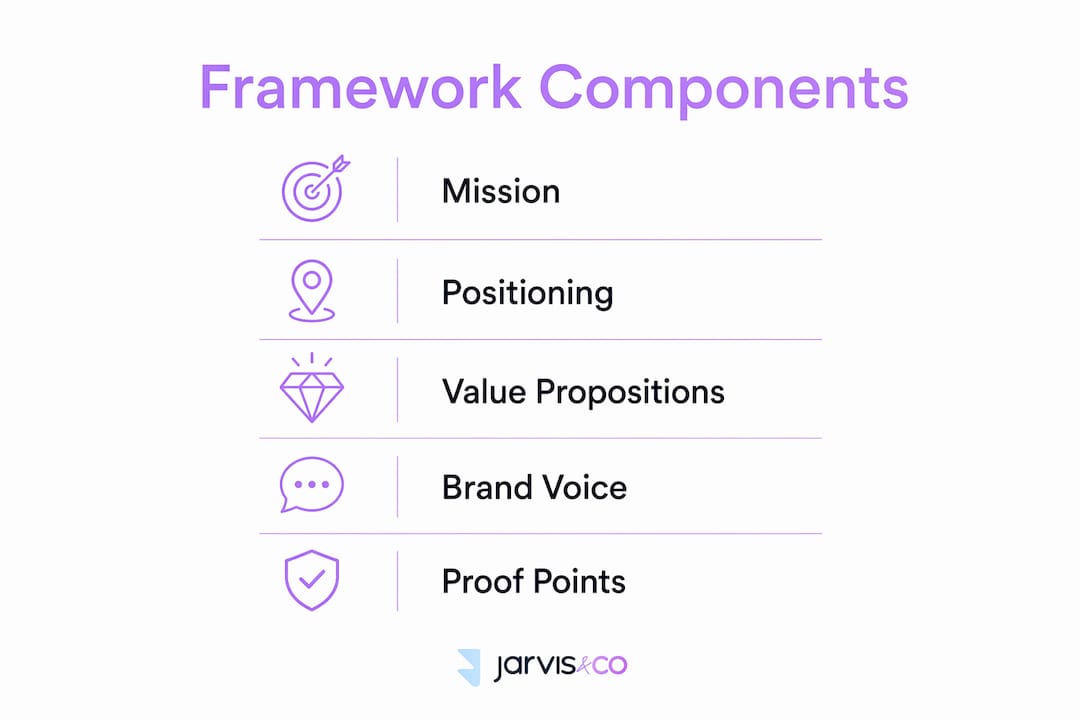
The five core layers are:
-
Mission. Your reason for existing. This rarely changes and informs every other layer. It answers “why does this business exist?”
-
Positioning. Where you sit in the market relative to alternatives. This defines who you serve and what makes you different. It shifts only when your market or strategy changes significantly.
-
Value propositions. The specific benefits you deliver to customers. Limiting messaging pillars to 3–5 improves memorability and keeps communication focused. Fewer than three risks one-dimensionality; more than five dilutes clarity.
-
Proof points. The evidence that supports your value propositions. These include case studies, certifications, data, and client results. They require quarterly review as your business grows.
-
Channel copy. The specific words used in ads, emails, social posts, and web pages. This layer changes most frequently and draws directly from the layers above it.
Positioning answers “why us over alternatives.” A value proposition answers “what specific benefit do you get?” Conflating the two is one of the most common mistakes marketers make when building their first framework.
Pro Tip: Audit your existing marketing materials before building your framework. If you cannot map each piece of copy to a value proposition or proof point, your messaging hierarchy has gaps.

| Component | Purpose | Update cadence |
|---|---|---|
| Mission | Defines brand purpose and direction | Rarely, only on major strategic shifts |
| Positioning | Differentiates brand in the market | Every 2–3 years or on market change |
| Value propositions | Communicates specific customer benefits | Annually or when offerings change |
| Proof points | Provides evidence for claims | Quarterly |
| Channel copy | Delivers messages on specific platforms | Continuously, based on performance data |
How to create an effective brand messaging framework from scratch
Building a framework from scratch requires input from multiple parts of your business. A well-built framework draws on leadership vision, competitive intelligence, customer research, product data, and testing feedback. Each input feeds a different layer.
-
Define your mission. Work with your leadership team to articulate why the business exists beyond making money. This statement should be specific enough to guide decisions but broad enough to remain stable over time.
-
Conduct competitor analysis. Map where your closest alternatives position themselves. Identify the gaps in their messaging. Your positioning should occupy a space they do not own, or own it more credibly than they do.
-
Research your customers. Interview existing customers and analyse support conversations, reviews, and sales call recordings. The language customers use to describe your value is often better than anything a marketing team invents.
-
Build your value propositions. Prioritise the benefits that appear most frequently in customer research and align with your positioning. Write each one as a clear, single-sentence statement. Aim for 3–5 total.
-
Gather proof points. For each value proposition, collect at least two pieces of supporting evidence. Brands with clear, evidence-based value propositions achieve higher conversion and customer retention than those relying on generic claims. Proof points are what separate a credible framework from a wish list.
-
Adapt for channels. Take your value propositions and proof points and rewrite them in the format and tone appropriate for each channel. A LinkedIn post and a paid search ad serve different contexts, even when they carry the same core message.
-
Test and refine. Run A/B tests on headlines, value proposition statements, and proof point formats. Use performance data to update your channel copy first, then feed insights back up the hierarchy where warranted.
Pro Tip: Record your customer research verbatim. Direct quotes from customers often outperform polished marketing copy in A/B tests because they reflect the exact language your audience uses to describe their own problems.
What is the role of brand voice and tone within the messaging framework?
Brand voice and tone are not the same thing, and treating them as interchangeable weakens your framework. Brand voice is a fixed, internal personality consistent across all channels; brand tone is the variable emotional inflection tailored to context or audience. Voice stays constant. Tone shifts.
Think of it this way: your voice is who you are. Your tone is how you sound in a given situation. A brand that is direct and plain-spoken uses that voice in a product launch, a billing email, and a social media reply. The tone in each case differs. The launch feels energetic. The billing email feels calm and clear. The social reply feels warm.
Key voice traits to document:
-
The three to five adjectives that describe your brand’s personality
-
A “this, not that” boundary for each trait (for example, “warm but not cheerful,” “opinionated but not combative”)
-
Example rewrites showing the voice applied to real copy
Tone context mapping:
-
Marketing and launch content: higher energy, benefit-led
-
Customer support: calm, clear, solution-focused
-
Social media: conversational, responsive
-
Transactional emails: direct, reassuring
The biggest brand voice problem is lacking a clearly articulated point of view rather than just a list of adjectives. A defensible point of view anchors voice traits and gives writers something to work from. Adjectives alone produce inconsistent results.
Pro Tip: Document your voice traits with before-and-after example rewrites. This is especially important when using AI writing tools, which default to generic copy without explicit guidance. A voice guide with worked examples prevents drift across writers and platforms.
How to tailor a brand messaging framework for multiple audience segments?
One master framework does not mean one message for everyone. The most effective approach is to build audience-specific versions by reordering and emphasising different value propositions and proof points, without creating entirely separate frameworks. Audience-specific messaging matrices reorder and prioritise value propositions and proof points to resonate with distinct segments while preserving the integrity of the master framework.
A messaging matrix maps each audience segment to the value propositions and proof points most relevant to them, along with the emotional angle and call to action that fits their context. A B2B buyer cares about efficiency, risk reduction, and return on investment. An end consumer cares about ease, confidence, and outcome. Both can be served by the same master framework, but the emphasis shifts.
Tips for building audience-specific messaging:
-
Identify your two or three most distinct audience segments by decision-making criteria, not just demographics
-
For each segment, rank your value propositions by relevance rather than rewriting them from scratch
-
Adjust proof points to match the segment’s priorities (for example, a case study featuring a similar business for a B2B audience)
-
Test segment-specific headlines and calls to action before committing them to the framework
| Audience segment | Primary value proposition emphasis | Proof point type | Emotional angle |
|---|---|---|---|
| B2B decision-maker | Efficiency and measurable return | Case studies, data, certifications | Confidence and risk reduction |
| End consumer | Ease of use and outcome | Reviews, before/after results | Reassurance and aspiration |
| Internal teams | Clarity and speed of execution | Process examples, templates | Productivity and alignment |
Maintaining one master framework as the source of truth prevents brand fragmentation. Audience adaptation happens at the matrix level, not by rewriting your positioning or mission for each segment.
How does continuous testing and optimisation enhance the brand messaging framework?
A messaging framework is a living document, not a one-time deliverable. Regularly testing and refining messaging based on performance data builds a truthful, effective framework rather than one built on untested assumptions. The market changes. Customer language evolves. Proof points age. Your framework needs to keep pace.
The most practical testing approach starts at the channel copy layer. Run A/B tests on ad headlines, email subject lines, and landing page value proposition statements. The winning variants reveal which proof points and value propositions resonate most with each segment. Feed those insights back up into the framework during your next scheduled review.
Messaging frameworks should be reviewed at least quarterly for proof points and annually for full updates, with triggered reviews when a significant product change or competitive shift occurs. Quarterly reviews keep your evidence current. Annual reviews catch positioning drift before it becomes a problem.
Pro Tip: Set a calendar reminder for your quarterly proof point review. Outdated statistics or superseded case studies undermine credibility faster than any copy mistake. Fresh evidence keeps your framework persuasive.
Key takeaways
A brand messaging framework is the single most effective tool for producing consistent, persuasive communication across every channel and audience segment your business serves.
| Point | Details |
|---|---|
| Build in layers | Structure your framework from mission down to channel copy, with each layer informing the next. |
| Limit value propositions | Keep messaging pillars to 3–5 to maintain memorability and avoid diluting your core message. |
| Separate voice from tone | Document voice as a fixed personality and tone as a context-specific adjustment to prevent inconsistency. |
| Use audience matrices | Reorder value propositions and proof points per segment rather than building separate frameworks. |
| Review on a schedule | Audit proof points quarterly and conduct a full framework review annually or after major changes. |
Why most brand messaging frameworks fail before they are finished
The frameworks I see fail most often are not poorly structured. They are poorly owned. A business spends weeks defining its mission and value propositions, then files the document somewhere no one reads it. The copy on the website still reflects a positioning from three years ago. The social media manager has never seen the voice guide. The framework exists, but it does not function.
The second failure pattern is treating voice as decoration. A list of adjectives like “friendly, professional, and approachable” gives a writer almost nothing to work with. Defining brand voice as a fixed, operational system with explicit boundaries and worked examples is what separates a usable guide from a mood board. This matters even more now that AI writing tools are part of most marketing workflows. Without a voice guide built around specific traits and boundaries, AI-generated content defaults to the blandest possible version of your brand.
The businesses I have seen get the most value from their frameworks are the ones that treat it as infrastructure, not a project. They assign ownership, schedule reviews, and connect their LinkedIn content strategy and other channel plans directly to the framework. The result is faster briefing, more consistent output, and copy that actually reflects what the business stands for.
If you are building your first framework, start with the mission and one strong value proposition backed by two proof points. Get that working before you build out the full hierarchy. A small, functional framework beats a comprehensive one that nobody uses.
— Luke
How Jarvisandco can help you build a clearer brand
Your brand messaging framework only delivers results when it is reflected consistently across your website, visual identity, and content. Jarvisandco is a creative design agency with over 15 years of experience helping businesses across the UK, including Cheshire East, build brands that communicate clearly and convert visitors into customers.

Whether you need a custom website design that brings your messaging to life or a bespoke logo that anchors your visual identity, Jarvisandco builds everything around your brand’s core message. Get in touch and we will get back to you promptly to discuss what your brand needs.
FAQ
What is a brand messaging framework?
A brand messaging framework is a structured hierarchy connecting your brand’s mission, positioning, value propositions, proof points, and channel copy. It ensures every piece of communication is consistent and aligned with your brand strategy.
How many value propositions should a brand have?
A brand should have 3–5 value propositions. Fewer than three risks one-dimensionality, while more than five dilutes clarity and reduces memorability across audiences.
What is the difference between brand voice and tone?
Brand voice is the fixed personality behind all communication; brand tone is the variable emotional inflection that shifts depending on context, such as a product launch versus a customer support reply.
How often should a brand messaging framework be updated?
Proof points should be reviewed quarterly, and the full framework should be evaluated annually or whenever a significant product change or competitive shift occurs.
Can one framework work for multiple audience segments?
Yes. Build one master framework and create audience-specific versions by reordering and emphasising different value propositions and proof points using a messaging matrix, without rewriting the core framework.