Every product page is both a search result and a sales page. Treat it as one or the other and you lose. The single most important change you can make right now is to add valid Product schema. Everything else builds from there.
Here is your immediate checklist:
- Title tag: include the product name and one key attribute; keep it under 65 characters
- Meta description: write a unique one per product; aim for 150–156 characters with a clear benefit
- Canonical tag: set it on every product URL, especially for variants and filtered pages
- Primary image ALT text: describe the product specifically, skip "image of"
- Product schema: add
name,image,price,priceCurrency,availability, andskuat minimum - First 150 words: name the product, its key benefit, and who it is for
- Review snippet eligibility: include
AggregateRatingin your schema if you have reviews - Internal link: make sure at least one category or buying-guide page links to this product
If you can only make one change today, add and validate your Product schema.
Table of Contents
- Why product-page SEO matters for UK stores
- 1. On-page content, meta, headings, UGC, and reviews
- 2. Technical must-haves: speed, indexability, and faceted navigation
- 3. Product schema, rich results, and common pitfalls
- 4. Conversion elements that also support search performance
- 5. What to measure and how to run A/B tests
- 6. Typical costs for product-page SEO in the UK
- 7. Your 30/60/90 day product-page SEO roadmap
- Key takeaways
- Jarvisandco can help you get this right
Why product-page SEO matters for UK stores
Google Shopping, organic listings, and AI-generated answers all pull from the same source: your product page. Get it right and you appear in multiple places at once. Get it wrong and even a well-stocked store stays invisible.

Structured data is the primary eligibility gate for rich results. Without it, your price, availability, and star rating will not appear in search results, regardless of how good your copy is. For UK stores, that gap is commercial: shoppers searching on mobile expect to see price and stock before they click.
Product pages also feed your site's overall authority. Category pages and buying guides pass ranking signals down to individual products through internal links. A product page that sits in isolation, with no links from category or guide pages, starts at a disadvantage before a single word of copy is written.
UK-specific factors add another layer. Mobile-first shopping behaviour means your page speed and layout matter as much as your keywords. Displaying prices in GBP, clear delivery timelines, and a visible returns policy are trust signals that reduce bounce rate and support dwell time, both of which feed back into search performance.
1. On-page content, meta, headings, UGC, and reviews
Good on-page SEO for products starts with the title tag. Format it as: [Product name] + [key attribute] + [brand or category]. Keep it under 65 characters. Avoid filler words like "authentic" or "amazing" that consume space without adding meaning.
Your meta description will not directly move rankings, but it drives clicks. Write one unique description per product. State the key benefit, include a price or delivery hook where relevant, and stay within 150–156 characters.
URL and canonicals: build URLs around the product name. For colour or size variants, either use one canonical URL per sellable product or set a canonical pointing to the primary variant. Never leave parameter-generated URLs uncontrolled.
H-tags and descriptions: your H1 should name the product and its primary differentiator. Use H2s for benefits, specifications, delivery and returns, and reviews. Get the product name and its main keyword into the first 150 words. Avoid copying the manufacturer's description verbatim — it creates duplicate content across thousands of stores.
Write descriptions that answer the questions blocking purchase: what it does, who it suits, how to use it, and what is in the box. A commonly cited minimum for a full description is around 400 words; for high-margin or high-traffic products, 800–1,500 words structured with headings and lists is worth the effort.
Images: use descriptive filenames (blue-running-shoes.jpg, not IMG_0123.jpg). Write ALT text under 125 characters that describes what the image shows. Serve images in WebP or AVIF format and compress them without visible quality loss.
Reviews and UGC: include AggregateRating schema alongside your Product schema. Place a review snippet near the CTA, not buried below the fold. Make it easy for customers to leave reviews post-purchase; a simple follow-up email is enough.
Pro Tip: Link from your category pages and buying guides to each product page. Product pages often gain rankings through those internal links, not from the product page itself.
2. Technical must-haves: speed, indexability, and faceted navigation
A product page that loads slowly or is accidentally set to noindex will not rank, regardless of how well the content is written.
Indexability checklist:
- Confirm
robots.txtdoes not block product URLs - Check for accidental
noindextags on live product pages - Set canonical tags on all variant and parameter URLs
- Add
hreflangtags if you serve different UK regions with separate URLs
Core Web Vitals: prioritise Largest Contentful Paint (LCP) on product pages. The primary product image is almost always the LCP element. Lazy-load images below the fold, preload the hero image, and defer non-critical JavaScript. Use critical CSS inline to prevent render-blocking.
Faceted navigation is one of the most common sources of crawl waste on e-commerce sites. Apply noindex or canonical tags to filter combinations that have no genuine search demand. Only create indexable facet URLs where a specific combination (e.g. "red leather sofa") has real, stable search volume.
Variant handling: the recommended approach is one indexable URL per sellable product with meaningful demand. Canonicalise minor variants (size, finish) back to the primary product URL unless each variant has its own distinct search demand.
Treating schema as an implementation priority means validating Product JSON-LD on the page and confirming feed parity for pricing and availability between the page and your Merchant Centre. Discrepancies between the two are a common reason stores lose Shopping eligibility.
Pro Tip: Server response time (TTFB) under 200ms is a reasonable target for product pages. If you use a product configurator or dynamic pricing, load those elements conditionally after the main page content has rendered.
3. Product schema, rich results, and common pitfalls
Structured data is effectively mandatory for product pages seeking enhanced SERP features in 2026. Without it, you are not eligible for price, availability, or rating snippets.
Mandatory properties for rich results:
nameimage(at least one high-resolution image URL)priceandpriceCurrency(useGBPfor UK stores)availability(e.g.https://schema.org/InStock)skuAggregateRatingwithratingValueandreviewCount
Common pitfalls: incorrect priceCurrency (using USD on a UK store), missing availability, and a mismatch between the price on the page and the price in your Google Merchant Centre feed. Any of these will remove your eligibility for Shopping and rich results.
Google's structured data documentation states that the
priceandavailabilityvalues in your schema must match what is shown on the page. A product markedInStockin schema but showing "out of stock" in the page copy will fail validation.
Validation steps: use Google's Rich Results Test and the Schema Markup Validator after any schema change. Set up a Search Console alert for structured data errors. Check feed parity between your page and Merchant Centre at least monthly for high-traffic products.
For local business schema guidance that complements your product schema, that resource covers the trust-signal layer in more detail.
4. Conversion elements that also support search performance
Conversion rate and SEO are not separate problems. Dwell time, bounce rate, and CTR all feed back into how Google evaluates your page.
Core CRO elements for product pages:
- A clear, high-contrast Add to Cart button above the fold
- Price displayed prominently in GBP with any discount shown
- Delivery estimate and returns summary visible without scrolling
- Product variant selector that does not reload the page
- A review snippet near the CTA, not only at the bottom of the page
Trust signals that lift both conversions and search credibility include verified reviews, a clear returns policy (e.g. 30 days), secure checkout badges, and visible merchant contact information. Shoppers who read negative reviews before purchasing actually convert at a higher rate, so do not hide them.
Microcopy matters. "Only 3 left in stock" next to a real inventory count, "Order by 2 PM for next-day delivery," and "Free returns within 30 days" each reduce hesitation at the exact moment a shopper is deciding. These small additions improve behavioural metrics that search engines can observe.
Pro Tip: Place a short FAQ block near the CTA, not at the bottom of the page. Two or three questions that address the most common objections ("Will this fit a king-size bed?") reduce exit rate and give you structured content that can appear in AI-generated answers.
For Shopify conversion benchmarks specific to UK stores, that guide covers the numbers worth targeting.
5. What to measure and how to run A/B tests
KPI table for product pages:
| KPI | What it tells you |
|---|---|
| Impressions | Indexing and schema health |
| CTR | Title and meta quality; rich result eligibility |
| Sessions | Overall visibility |
| Add-to-cart rate | Page persuasiveness |
| Conversion rate | End-to-end purchase friction |
| Revenue per visitor | Combined SEO and CRO performance |
| Review-driven CTR | Schema and social proof effectiveness |
GA4 event checklist:
view_itemon page loadadd_to_carton button clickbegin_checkouton checkout entrypurchaseon order confirmation
A/B testing guidelines:
- Score each test on impact, confidence, and ease before running it. High-scoring tests run first.
- Run tests long enough to reach statistical significance. Do not call a winner after two days.
- Sequence tests: content changes first (titles, descriptions), then UX (layout, CTA placement), then technical (speed, schema).
- Read results by segment: mobile vs desktop, new vs returning visitors.
Report weekly during an active test. A successful content test typically shows a measurable CTR lift within 2–3 weeks. A UX test needs at least 2–4 weeks and sufficient traffic to be reliable.
Marketing efficiency frameworks can help you prioritise which product pages to test first based on revenue impact.
6. Typical costs for product-page SEO in the UK
UK pricing for product-page SEO varies by scope. Here are realistic ranges:
- Audit only: £500–£2,000 for a focused product-page audit covering schema, technical issues, and on-page recommendations
- Hourly consultancy: £75–£150 per hour for an experienced UK SEO specialist
- Monthly retainer (optimisation): £800–£3,000 per month for ongoing implementation, testing, and reporting
A proper audit should include: a crawl report, schema validation results, Core Web Vitals data, canonical and indexability review, internal linking map, and a prioritised recommendations list.
Questions to ask any agency:
- What does your audit deliverable include?
- How do you handle schema validation and feed parity?
- Can you show an example of a product-page project with measurable results?
- What is your reporting cadence and what KPIs do you track?
Red flags: promises of page-one rankings within days, no mention of testing or measurement, no structured-data work in their process, and vague deliverables with no timeline.
For a broader view of SEO agencies in the UK and what to expect from each tier, that resource covers the market in detail.
Internal vs agency split: handle content updates and review generation in-house. Brief an agency or developer for schema implementation, technical fixes, and A/B test infrastructure.
7. Your 30/60/90 day product-page SEO roadmap
| Phase | Priority tasks | Owner | Expected outcome |
|---|---|---|---|
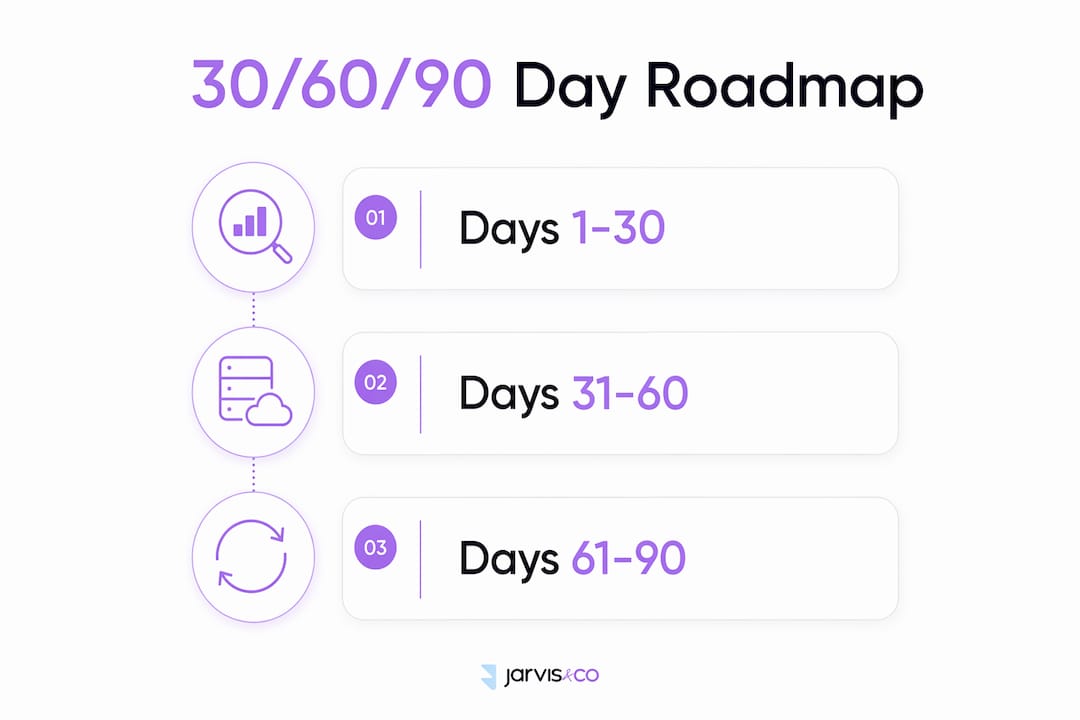
| Days 1–30 | Audit top 20 product pages; fix title tags and meta; add/validate Product schema; set canonicals | SEO lead or agency | Schema errors resolved; rich result eligibility restored |
| Days 31–60 | Fix Core Web Vitals on priority pages; implement internal linking from category pages; launch review generation email | Developer + SEO | LCP improvement; category-to-product link equity flowing |
| Days 61–90 | Run first A/B tests (title and CTA copy); scale description improvements to more products; measure revenue per visitor | SEO + CRO | Measurable CTR and conversion lift on tested pages |
30-day priorities are about fixing what is broken: schema errors, missing canonicals, and thin titles. These are the changes with the fastest measurable impact.

60-day priorities shift to infrastructure: technical performance, internal linking, and the review pipeline. These take longer to show in rankings but compound over time.
90-day priorities are about iteration. Use the data from your GA4 events and Search Console to decide which tests to run next and which product pages to prioritise for deeper content work.
Key takeaways
Effective product page SEO combines valid schema, clean technical foundations, and conversion-focused content — measured consistently through GA4 and Search Console.
| Point | Details |
|---|---|
| Schema first | Add and validate Product schema before any other change; it gates rich result eligibility. |
| Titles and metas | Keep title tags under 65 characters with the product name and a key attribute; write unique meta descriptions per product. |
| Internal linking | Link from category pages and buying guides to product pages; products rarely rank well in isolation. |
| Page speed | Prioritise LCP on product pages; the hero image is almost always the bottleneck. |
| Measure consistently | Track view_item, add_to_cart, and purchase events in GA4; report weekly during active tests. |
| Jarvisandco | Jarvisandco follows an audit-first, schema-led approach to product-page SEO for UK e-commerce stores. |
A practitioner's note from Jarvisandco
The most common mistake we see on UK product pages is treating schema as optional. It is not. Without valid Product schema, a page is simply not eligible for the price, availability, and rating snippets that make a listing stand out in search results. Every project we take on starts with a schema audit for exactly this reason.
The second mistake is optimising product pages in isolation. Product pages inherit ranking power from site architecture. Strengthening category pages and routing internal links to target products is often the fix that moves non-brand rankings, not adding more copy to the product page itself.
Jarvisandco favours a schema-first, measurement-driven approach: audit, implement, validate, then test. It is less exciting than a complete redesign, but it is what actually moves the numbers.
Jarvisandco can help you get this right
If your product pages are not showing price, availability, or rating snippets in Google, or if your conversion rate is lower than it should be, Jarvisandco can help. We offer a focused product-page audit that covers schema validation, technical health, on-page content, and internal linking, followed by a clear implementation plan.

What the starter engagement includes:
- Full schema audit and validation report
- Core Web Vitals review for your top product pages
- Title tag and meta description recommendations
- Internal linking map from category to product pages
- A prioritised 30/60/90 day action plan
We work with e-commerce stores across the UK, from Shopify builds to custom platforms. Whether you need the full implementation or just a clear brief to hand to your developer, we can help.
Get in touch with Jarvisandco or view our website design and e-commerce services to see how we approach product-page projects.
Useful sources and validation tools
Use Google's Rich Results Test and the Schema Markup Validator after every schema change. Set up Search Console alerts for structured data errors and check feed parity between your product pages and Google Merchant Centre at least monthly.
Validation tools:
- Google Rich Results Test
- Schema Markup Validator
- Google Search Console (Coverage and Enhancements reports)
Further reading:
- Yoast — product page SEO for structured data guidance
- Conductor — product page SEO for site architecture and internal linking
- Schema.org Product type for official property definitions
Monitoring suggestion: schedule a monthly schema check for your top 20 product pages and set a Search Console alert for any new structured data errors. Catch issues before they affect your Shopping eligibility.