A brand refresh updates how you show up; a rebrand changes who you are trying to be. If the strategy underneath your brand is still right, refresh it. If your positioning, audience, or story no longer matches what the business actually does, you need a rebrand. Answer that one question honestly, then check it against the diagnostic checklist below before you spend a penny.
TL;DR:
- A brand refresh updates visual elements while keeping the core strategy and audience the same, typically completed in one to three months at lower cost.
- A rebrand rebuilds strategy first, often changing the name, positioning, or target market, requiring four to nine months and costing from £25,000 or more.
- The decision depends on whether your business’s actual market position and audience have shifted significantly, as indicated by a score of 7 or higher on the diagnostic checklist.
- Key signs for a rebrand include confusion in sales or recruitment, a mismatch in pricing and value, or reputational events requiring strategic change.
- Proper planning, stakeholder alignment, and clear goals are crucial; skipping audits or internal buy-in is a common failure that can make rebrands costly and ineffective.
Table of Contents
- Rebrand vs refresh: what each one actually involves
- How do a refresh and a rebrand differ in practice?
- Which one do you actually need? A 10-question checklist
- What does a refresh or rebrand actually cost and take?
- Where rebrand projects usually go wrong
- What agency casework actually shows
- Rollout checklist: from discovery to launch
- When is it time to call in outside help?
- Ready to decide? Get a clear next step from Jarvisandco
- Sources
Rebrand vs refresh: what each one actually involves
A brand refresh updates the visual execution of a brand while its underlying positioning stays intact. Think of it as a repaint, not a rebuild. A refresh typically touches:
- Logo styling and colour palette (softer edges, a more current typeface, a tidier mark)
- Photography and imagery style, moving from stock shots to bespoke brand photography
- Messaging tweaks that sharpen tone without changing what the business claims to be
- Website styling and templates, without a change to the domain or core navigation
A full rebrand rebuilds the strategy first, then rebuilds the identity to match it. That distinction matters more than people assume: a refresh updates visual execution while a rebrand rebuilds strategy first, and skipping that order is where most projects go wrong. A rebrand typically involves:
- A new or repositioned name, or a change to brand architecture (how sub-brands relate to the parent)
- A shift in positioning, target audience, or pricing signalling
- New visual identity built from that new strategy, not layered on top of the old one
- Full website rebuild, often with domain migration
A regional accountancy firm that simply tidies its logo and swaps stock photography for real staff portraits is refreshing. A firm that repositions from "local bookkeeping" to "growth advisory for scaling SMEs," changes its name, and re-prices its packages accordingly is rebranding.
How do a refresh and a rebrand differ in practice?
The two options diverge sharply once you look past the surface. Here's how they compare across the axes that actually decide a project's success.
| Factor | Brand refresh | Full rebrand |
|---|---|---|
| Scope | Visual and messaging execution; strategy untouched | Positioning, name, architecture, pricing signal, then identity |
| What's preserved | Name, core positioning, existing brand equity | Little; even the name may change |
| Typical timeline | usually a few months | often several months |
| Cost band | Roughly £10,000–£40,000 for SMEs | Often from £25,000 upward, scaling with scope |
| Risk to brand equity | Low; customers usually barely notice | Higher; existing recognition can be lost temporarily |
| Best suited to | Businesses whose strategy is sound but looks dated | Businesses whose market position, audience, or story has genuinely changed |
Scope is the clearest divider. A refresh preserves the name and the promise, updating only how that promise is expressed. A rebrand can touch everything, including the name itself.
Timeline follows directly from scope. Refresh projects often complete in one to three months, while full rebrands commonly need four to nine months or more, because strategy work, stakeholder alignment, and legal name checks all take real calendar time before any design begins.
Cost tracks the same logic. Refreshes for small and mid-sized businesses commonly run from roughly £10,000 to £40,000, while rebrands typically start higher, driven by naming, legal clearance, and the sheer number of touchpoints that need rebuilding.
Risk is where businesses underestimate rebrands most. Changing a name or repositioning a business can confuse existing customers and dilute years of built-up recognition if the transition isn't handled carefully. A refresh carries almost none of that risk, because the thing customers already trust stays recognisably the same.
Fit comes down to one simple test: does the business you are today match the brand you're presenting? If yes, refresh. If the gap has grown, a rebrand is the only option that closes it properly.
Which one do you actually need? A 10-question checklist
Run through these ten questions honestly before committing to either path. Score each one: 0 for "no", 1 for "somewhat", 2 for "yes".
- Has your target audience changed since the brand was last defined?
- Does your current pricing feel out of step with the value you now deliver?
- Has the business added products, services, or a merger that the current brand doesn't reflect?
- Do sales conversations regularly involve explaining what you actually do, beyond what the brand suggests?
- Is the company name causing confusion, embarrassment, or legal friction?
- Has a merger, acquisition, or ownership change made the current brand architecture unworkable?
- Are you struggling to recruit because the brand doesn't match the calibre of talent you need?
- Has a reputational event forced a genuine reset, not just a facelift?
- Is the core visual identity simply dated, while the strategy and story still hold up?
- Would customers be confused, rather than pleasantly surprised, by a totally new name?
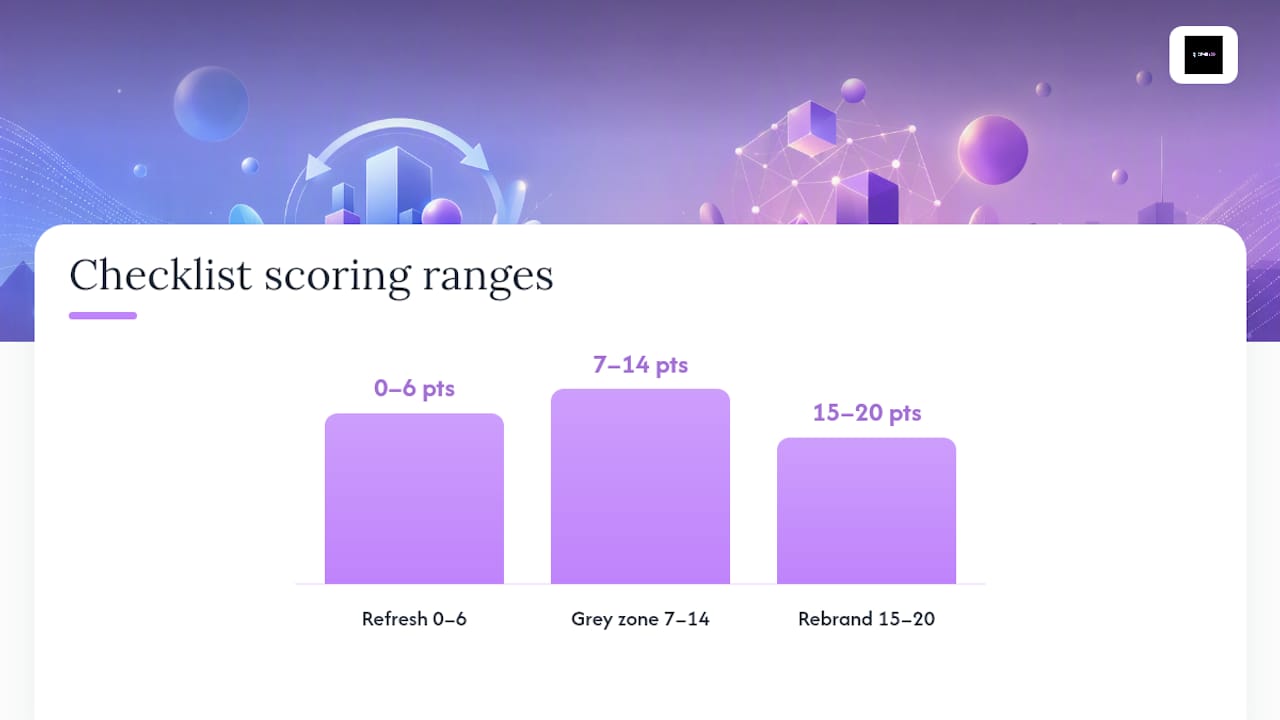
Scoring guide: 0 to 6 points suggests a refresh will solve your problem. 7 to 14 points is a genuine grey zone, worth a proper diagnostic conversation before committing either way. 15 to 20 points means the strategy underneath your brand has moved, and only a rebrand will close that gap. Practical guidance from brand strategists backs this weighting: if the underlying positioning or audience has shifted, a rebrand is usually required; if only the visual execution has dated, a refresh does the job.
Recurring friction signals matter more than any single answer. Repeated friction in sales conversations, recruitment mismatches, or a pricing gap against perceived value are the three signs that most reliably point toward a rebrand rather than a refresh.
Pro Tip: Ask three separate people in the business (a salesperson, a new starter, and a long-standing customer) to describe the brand in one sentence. If those three sentences tell wildly different stories, that's a stronger signal than any single checklist answer.
What does a refresh or rebrand actually cost and take?
A refresh moves through four fairly compact phases: discovery, design, asset update, and roll out. Most SME refreshes complete inside six to twelve weeks, with the bulk of that time spent on design iteration rather than research, since the underlying strategy already exists.
A rebrand needs more phases and far more calendar time: audit, positioning, identity, naming (if applicable), website rebuild, migration, and launch. Full rebrands commonly take four to nine months or longer, and that estimate assumes stakeholder alignment doesn't stall the process, which it often does in businesses with multiple decision-makers.
Cost bands worth budgeting against, based on typical SME projects:
- Refresh: roughly £10,000 to £40,000, depending on the number of touchpoints and whether photography or video is included
- Rebrand: typically from £25,000 upward, with legal name clearance, trademark searches, and multi-market rollout pushing costs higher still
- Detailed UK branding cost bands are worth reviewing before you set a budget internally
The biggest cost drivers are rarely the design work itself. Naming (with the legal and trademark checks that follow), brand architecture complexity, the sheer number of physical and digital touchpoints, and international rollout requirements all add cost far faster than the creative process does.
If a rebrand includes a domain change, SEO migration has to be planned as its own workstream, not an afterthought. Content mapping, staged 301 redirects, and a carefully sequenced launch protect your existing search rankings during the switch. Rushing this step is one of the fastest ways to lose organic traffic that took years to build.
Where rebrand projects usually go wrong
The single most expensive mistake is what practitioners call the "half rebrand": a new logo and colour palette layered onto positioning that was never actually fixed. It looks like progress, feels like progress, and solves nothing, because the strategic problem that triggered the project in the first place is still sitting underneath the new paint.
Other recurring failure modes:
- Skipping the audit. Most rebrands that fail do so because early steps, particularly the audit and stakeholder alignment, were rushed or skipped entirely. Locking positioning before any creative work begins is what separates projects that succeed from ones that don't.
- Launching without internal buy-in. If staff hear about the new brand at the same time as customers, expect confusion and, in worse cases, active resistance from the people meant to represent it.
- Measuring the wrong things. Tracking "likes" on a launch post tells you nothing. Track lead quality, conversion rate, and recruitment applications over the following two quarters instead.
- Confusing customers at launch. A rebrand with no clear "why" message leaves loyal customers assuming something has gone wrong, rather than understanding what's changed and why it's good news for them.
Pro Tip: Draft your internal announcement before your external one. Staff should never learn about a rebrand from a customer.
What agency casework actually shows
Jarvisandco's case study with Leigh & Co is a useful illustration of when a full rebrand, rather than a refresh, was the right call. The business had outgrown its original positioning, and its existing identity no longer matched the calibre of client it was trying to attract. The chosen route was a full rebrand: new identity, new website, and messaging rebuilt around the business it had actually become, not the one it started as.
By contrast, the Level Up Fitness project shows a full brand identity build rather than a partial patch, reinforcing the same principle from a different angle: get the strategy settled first, then let the visual identity follow from it rather than lead it.
What tends to matter most across projects like these is not the creative work itself, but the groundwork underneath it:
- Proper scoping before any design begins, so the brief reflects the real business problem, not just a stale logo
- Genuine stakeholder alignment early, so launch day doesn't surprise anyone inside the business
- A measurement plan agreed before launch, not invented afterwards to justify the spend
If your business is somewhere in that seven-to-fourteen-point grey zone from the checklist above, that's usually the right moment to bring in outside perspective. A first conversation with an agency should feel like a diagnostic, not a pitch: expect questions about your audience, your pricing, and your growth plans before anyone mentions a logo.
Rollout checklist: from discovery to launch
Whichever path you choose, the sequence matters more than the speed. Follow this order:
- Run a full brand audit: current positioning, competitor set, customer perception, and internal alignment on what the business actually sells today.
- Interview key stakeholders (leadership, sales, and a sample of customers) and document where their descriptions of the brand diverge.
- Lock positioning and messaging before any visual design work starts.
- Get formal sign-off on positioning from leadership. This is the first approval gate, and skipping it is the leading cause of rework later.
- Develop the visual identity (or the refreshed execution) against the locked positioning.
- Build or update the website, including SEO migration planning if the domain or URL structure changes.
- Get a second sign-off on the finished identity and website before any public rollout begins.
- Brief internal staff first, with a clear explanation of why the change is happening.
- Launch externally on a fixed date, with all touchpoints (signage, social, email, print) updated simultaneously rather than piecemeal.
- Track lead quality, conversion rate, and search visibility for at least two full quarters post-launch, comparing against pre-launch baselines.
If updated messaging touches how you present to candidates or the public, check it against Disability Confident guidance to make sure the new brand voice stays genuinely inclusive rather than accidentally narrowing who feels welcome.
When is it time to call in outside help?
Businesses tend to call an agency when the checklist above lands in that murky middle ground, or when internal teams can see the problem but keep circling it without resolution. That second pattern is the one worth watching for: if the same conversation about "the brand feeling off" keeps happening at leadership meetings without ever producing a decision, that stalling is itself a signal.
A good first diagnostic call shouldn't start with mock ups. It should start with questions: who buys from you now, what you actually sell today versus what you sold when the brand was built, and where the gap between those two things is causing real commercial pain. If the answers point to a strategy problem, a rebrand conversation follows. If they point to something more like fatigue with the current look, a refresh conversation follows instead.
The most useful next step is rarely "get a new logo." It's a proper audit against the checklist above, scored honestly, before a single creative brief gets written.
— Luke
Ready to decide? Get a clear next step from Jarvisandco
An experienced creative agency is the practical alternative to guessing your way through a rebrand or refresh alone. Unlike hiring a freelance designer for a quick logo swap, or trying to run a full repositioning exercise in-house without dedicated strategy input, The agency runs the audit first and scopes the project to match what your business genuinely needs, whether that's a focused refresh or a full identity rebuild.
Jarvisandco's services cover the full range either path requires: branding and identity work, full rebrand delivery including naming and positioning, and website design built to match the new strategy rather than bolted onto the old one. For property-facing or developer clients, partners like Visual Trick's marketing CGI can strengthen how a refreshed or rebranded identity shows up in visual marketing. Review the UK branding cost guide and the Leigh & Co case study to see realistic budgets and outcomes side by side. If your checklist score puts you in the grey zone, book a discovery conversation with Jarvisandco and get a straight answer on which path actually fits your business.
Sources
For deeper reading beyond this guide, these sources cover the frameworks and checklists referenced throughout:
- Rebrand vs. Refresh: Which Does Your Business Actually Need? | Patrick Iverson
- How to rebrand successfully | HubSpot blog
- Disability Confident