
For Bedford small businesses, the clearest recommendation is a bespoke, conversion-first website built by a local agency that understands your customers and your goals. A template site might look presentable, but it rarely answers the three questions every visitor asks within seconds: are you real, do you serve people like me, and how do I reach you right now?
A website built around one primary conversion outcome — a phone call, a booking, a quote request — will consistently outperform a brochure site that tries to do everything at once.
Jarvisandco works with Bedford businesses to do exactly that. The process starts with a short discovery call where you talk through your goals, your customers, and what success looks like in measurable terms. From there, everything else follows.
Table of Contents
- What does a goal-driven small-business website actually include?
- How do you spot a credible local web designer?
- How does a typical web design project work?
- What does a small-business website cost in the UK?
- What questions should you ask before hiring a web designer?
- Why Jarvisandco is a strong choice for Bedford businesses
- Key takeaways
- What actually matters when you commission a website
- Ready to get your Bedford business online properly?
- Useful sources and further reading
What does a goal-driven small-business website actually include?
A well-scoped small-business site is not just a homepage and a contact page. For most service-based businesses, having multiple pages gives you the room to capture SEO traffic and convert it. Having very few pages often means missed opportunities on both fronts.
Here is what a properly built site should deliver:
- Core pages: Homepage, individual service pages (one per core service, not a single generic list), an About page, a Contact page, and at least one case study or testimonials page.
- Responsive design: The site must work cleanly on mobile. Mobile-first patterns in 2026 include simplified headers, prominent tap-to-call buttons, and booking shortcuts — not just a scaled-down desktop layout.
- CMS access and training: You should be able to update your own content without calling a developer every time.
- Technical SEO basics: Local schema markup, a linked Google Business Profile, correct page titles and meta descriptions, and a site that loads in under two seconds.
- One primary conversion element: A tap-to-call button, a booking form, or a quote-request form. Pick one and make it prominent everywhere.
- Analytics: Google Analytics 4 installed and configured from day one, so you can see what is working.
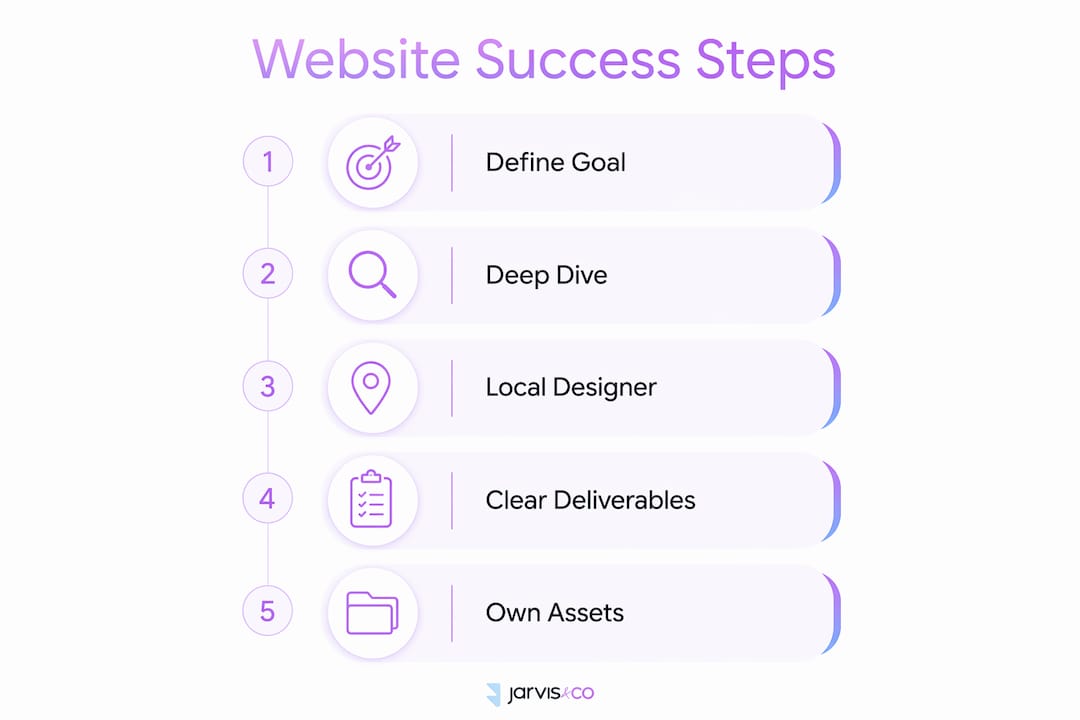
Pro Tip: Decide on your single primary conversion outcome before the design brief is written. If you want phone calls, every page should make calling the easiest thing to do. If you want form submissions, the form should never be more than one click away. Defining this early keeps the whole project focused.
High-converting sites use dedicated, deep-dive pages for each core service rather than a single generic "Services" page. Each of those pages acts as its own conversion engine, targeting a specific search query and a specific customer need. You can read more about the technical side in Jarvisandco's guide to SEO-friendly web design.
How do you spot a credible local web designer?
Portfolio and proof matter more than promises. When you are shortlisting Bedford web designers, look for these trust signals:
Trust signals must be sector-specific: a contractor needs licence details and project photos; a consultant needs case studies and a professional intake process. Generic five-star reviews are not enough on their own.
| Trust signal | What to look for |
|---|---|
| Local case studies | Named Bedford or Bedfordshire clients with measurable outcomes |
| Client testimonials | Specific results mentioned, not just "great service" |
| Before/after examples | Screenshots of old site vs new, with context |
| Star ratings | Google reviews with recent dates and detailed comments |
| Industry-relevant photos | Real project photos, not stock imagery |
When you review a portfolio, ask for live URLs, not just screenshots. Load the site on your phone, check the speed, and look at whether the contact or booking action is obvious within three seconds. If an agency cannot show you a live example in your sector, that is worth noting.

How does a typical web design project work?
A well-run project follows a clear sequence. Here is what to expect:
- Discovery (1–2 weeks): Goals, audience, competitors, and content audit. You provide brand assets, copy, and images, or agree on what the agency will produce.
- Content and wireframe (1–2 weeks): Page structure and content hierarchy agreed before any visual design begins.
- Visual design (2–3 weeks): Mockups for key pages, reviewed and signed off by you.
- Development (2–4 weeks): The approved design is built, CMS configured, and integrations connected.
- Testing (1 week): Cross-browser and cross-device checks, speed tests, form testing, and basic accessibility review.
- Launch (1–2 days): DNS transfer, final checks, and go-live.
- Post-launch support (typically 30 days): Bug fixes, training session, and handover of all assets.
For a standard small-business site, the total timeline usually spans a few months from kick-off to launch. Scope changes mid-project will extend that. Any reputable agency will handle change requests through a written process, with a clear note of any cost or time impact before work proceeds.
At each stage, insist on a clear deliverable and a sign-off point. Never move to development without approving the design, and never accept a launch without a CMS training session included.

What does a small-business website cost in the UK?
Pricing varies by scope, but here are the typical bands for bespoke work in the UK:
| Tier | Typical price range | What it usually includes |
|---|---|---|
| Entry-level bespoke | — | 5 pages, CMS, responsive design, basic SEO setup |
| E-commerce / Shopify | — | Product catalogue, payment integration, inventory management |
Beyond the build cost, budget for ongoing fees:
- Hosting: £10–£50 per month depending on the platform and traffic.
- Maintenance and security: £50–£150 per month for updates, backups, and monitoring.
- SEO retainer: Variable, but expect £300–£1,000 per month for active local SEO work.
- Content updates: Either included in a maintenance plan or billed hourly.
Watch out for agencies that lock your domain or hosting into their own accounts. You should own your domain, your hosting account, and all your website files outright. Fixed-price projects with staged payments (deposit, mid-point, completion) are the standard billing shape for bespoke work and protect both sides.
What questions should you ask before hiring a web designer?
Use this list in your first call or meeting:
- Can you show me three live examples in a similar sector?
- Who owns the domain, hosting, and all website files at the end of the project?
- Will I be trained to update the site myself?
- What does your change-request process look like?
- What is included in post-launch support, and for how long?
- How do you handle local SEO and schema markup?
- What does the payment schedule look like?
Pro Tip: Get the answers to questions 2 and 3 in writing before you sign anything. Ownership of your own assets and the ability to update your own content are non-negotiable.
Red flags to walk away from: no local client references, vague or verbal-only pricing, no CMS access included, guaranteed first-page Google rankings (no agency can promise this), and contracts that tie you to their hosting with no exit clause.
Why Jarvisandco is a strong choice for Bedford businesses
Jarvisandco is a UK creative agency with over 15 years of experience building websites and brands for small businesses, trades, healthcare providers, and property developers. The services relevant to a Bedford small business include:
- Bespoke website design and development, including Shopify and e-commerce builds
- Local SEO, schema markup, and Google Business Profile integration
- Brand identity, logo design, and professional photography
- Ongoing social media management and content support
The agency's approach is conversion-first: every project starts with a defined primary outcome, and the design is built to deliver it. Local discovery in 2026 depends on a combination of schema, local directories, and purposeful content targeting nearby queries — all of which Jarvisandco builds into the project from the start.
A bespoke website from Jarvisandco is built to answer the questions your Bedford customers are already asking — and to make contacting you the easiest next step they can take.
To get started, book a discovery call via the Jarvisandco website. You will talk through your goals, get a clear scope, and receive a written proposal with no obligation.
Key takeaways
A bespoke, conversion-first website built around one clear outcome is the most effective approach for Bedford small businesses looking to generate enquiries online.
| Point | Details |
|---|---|
| Define one conversion outcome first | Agree on your primary goal — call, form, or booking — before design begins. |
| Insist on asset ownership | Confirm in writing that you own your domain, hosting, and all website files. |
| Budget for ongoing costs | Hosting, maintenance, and SEO are recurring costs; factor them in from the start. |
| Check live portfolio examples | Request live URLs in your sector, not just screenshots, before committing. |
| Jarvisandco for Bedford | Jarvisandco delivers bespoke, conversion-focused websites for UK small businesses, with local SEO and ongoing support built in. |
What actually matters when you commission a website
The most common mistake Bedford business owners make is treating a website as a one-off design job rather than a business tool with a measurable job to do. A site that looks good but has no clear conversion path, no local schema, and a three-second load time on mobile will not bring in enquiries. The design is the last thing to worry about; the conversion architecture and the technical foundation come first.
The agencies that deliver results are those that ask about your goals before they talk about colours or fonts. If a designer leads with aesthetics and follows with price, that is a signal about their priorities.
Ready to get your Bedford business online properly?
Jarvisandco builds bespoke websites for small businesses across the UK — conversion-focused, technically sound, and built to bring in real enquiries from day one.
If you are based in Bedford and want a website that actually works for your business, the next step is straightforward. Visit the Jarvisandco website design service page to see examples of recent work and get in touch. You can also drop a message through the contact form and we will get back to you promptly to talk through your project.
Useful sources and further reading
- Google's Core Web Vitals documentation — the primary reference for page speed and user experience metrics; useful for checking what your current or proposed site should meet.
- Local business schema: a practical guide for 2026 — a step-by-step guide to structured data for UK small businesses, directly relevant to local search visibility.
- Google Business Profile optimisation guide for UK SMEs — practical advice on linking your GBP to your website and keeping your local listing accurate.
- How new businesses get discovered locally in 2026 — covers the mix of schema, directories, and content that drives local discovery today.
- Build trust with website design — a practical breakdown of the credibility features that encourage visitors to take action.