
Tone of voice guidelines are documents that translate your brand's personality into specific, adaptable communication styles across every channel, context, and audience. They sit at the heart of any serious brand voice strategy, giving content creators and marketing professionals a shared reference point that keeps messaging consistent without making it robotic. The distinction between a stable brand voice and a flexible brand tone is the most important concept these guidelines must capture. Get that distinction right, and every piece of content you publish feels unmistakably yours.
What are the core components of tone of voice guidelines?
Strong tone of voice guidelines contain far more than a list of adjectives. Authoritative guidelines include a voice spine, core characteristics with detailed explanation, a tone map, do/don't examples, language rules, and editing and quality assurance standards. Each element earns its place.
The voice spine
The voice spine is the stable foundation of your brand's personality. Think of it as the fixed point everything else orbits. It answers one question: who is this brand, always, regardless of what it is saying or where?

Core voice traits with guardrails
Three to five core traits define your voice. Each trait needs three things: what it means, what it sounds like in practice, and what it explicitly avoids. A trait like "direct" means getting to the point quickly. It does not mean blunt or dismissive. Without that boundary, writers default to their own interpretation, and consistency collapses.
- Direct: Clear, confident sentences. Not curt or cold.
- Warm: Friendly and human. Not overly casual or unprofessional.
- Expert: Knowledgeable and credible. Not jargon-heavy or condescending.
Tone dimension framework
Effective tone of voice guidelines include 4–6 primary tone dimensions with default positions and channel-specific shifts. Limiting dimensions to this range keeps the framework usable without oversimplifying. Each dimension is a spectrum with two poles, for example: formal to casual, serious to playful, reserved to enthusiastic. Your guidelines set a default position on each spectrum, then specify how that position shifts by channel or content type.
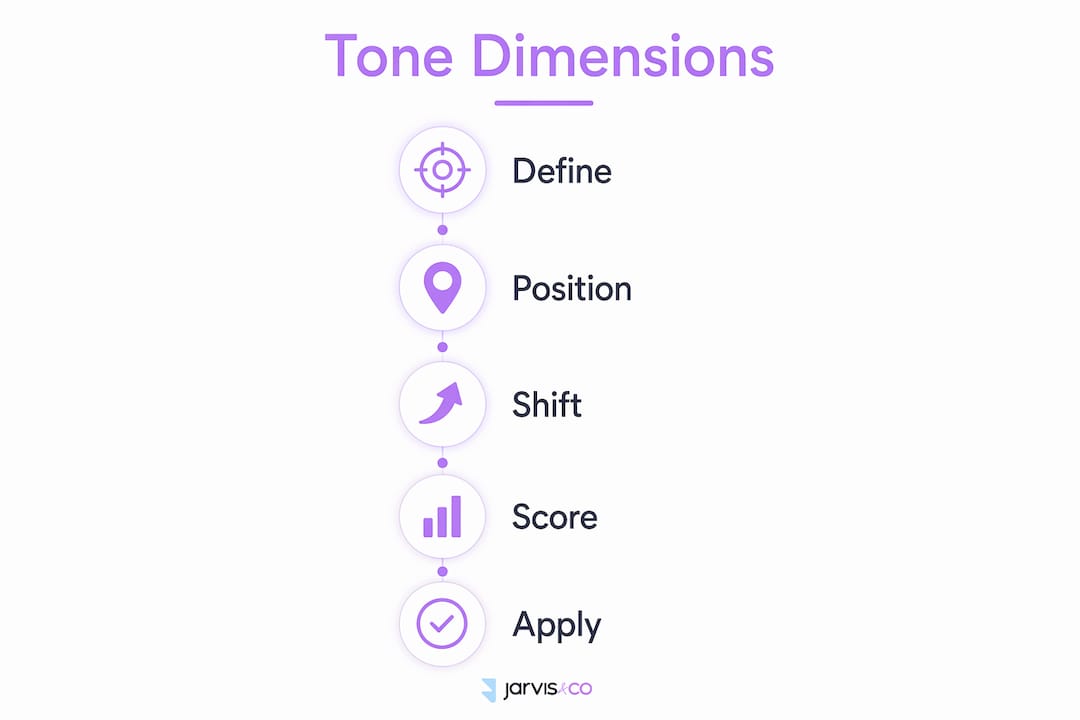
| Dimension | Default position | Social media shift | Customer support shift |
|---|---|---|---|
| Formal to casual | Slightly casual | More casual | Neutral |
| Serious to playful | Balanced | More playful | More serious |
| Reserved to enthusiastic | Moderately enthusiastic | High enthusiasm | Low enthusiasm |
| Expert to accessible | Accessible | Very accessible | Expert |
Tone scoring rubrics
Tone scoring rubrics assign numerical values to tone dimensions by content type, making subjective judgements objective and trainable. A score of 1 to 5 on a formal/casual dimension, applied per content type, gives writers a measurable target rather than a vague instruction. This matters especially when briefing freelancers or feeding prompts into AI content tools.
Pro Tip: Build your rubric into your content brief template. When a writer knows a LinkedIn article scores 2/5 on the casual dimension and a TikTok caption scores 5/5, they stop guessing and start writing correctly from the first draft.
How do brand voice and tone differ?
Brand voice is your stable personality. Brand voice is constant: it is who you are, not how you feel at a given moment. Tone is the variable emotional register you apply depending on context, audience, and channel. The same brand can use an urgent tone during a service outage and a celebratory tone when announcing a product launch, while its underlying voice remains unchanged.
Companies use nine or more distinct tones from a single brand voice for different situations. That range is not inconsistency. It is emotional intelligence applied to communication.
"Voice is constant. Tone is contextual. Confusing the two is the single most common reason brand communications feel incoherent or robotic. Document them separately, anchor tone to voice, and your content will always feel like it comes from the same place."
Failing to separate the two creates real problems. A brand that treats voice and tone as interchangeable either sounds identical in every situation (robotic) or sounds different in every situation (unrecognisable). Neither outcome builds trust.
Here is how the distinction plays out in practice:
- Apology email: Same voice (warm, direct), but tone shifts to humble and reassuring.
- Product launch post: Same voice, but tone shifts to excited and energetic.
- Crisis statement: Same voice, but tone shifts to calm, measured, and transparent.
- Onboarding message: Same voice, but tone shifts to encouraging and clear.
Documenting both separately in your guidelines gives writers an anchor. They know the voice never changes. They know the tone must change. That clarity removes ambiguity from every brief.
What practical frameworks help operationalise tone of voice?
Frameworks turn tone from a concept into a process. Without them, guidelines sit in a shared drive and gather digital dust.
Channel-specific tone shifts
Tone must flex by channel and context. TikTok and Instagram Reels typically require a tone that sits 1–2 points more casual and energetic relative to your default. LinkedIn favours a more formal and confident register. Email sits somewhere between the two, leaning personal and warm. Your guidelines should map these shifts explicitly, not leave writers to infer them.
Content type matrix
A content type matrix assigns tone scores to every format you produce regularly. Build it as a simple table with content types in rows and tone dimensions in columns. Populate each cell with a score from 1 to 5. The matrix becomes your most practical reference document because it answers the question "how should this feel?" before a word is written.
- List every content type you produce: social posts, blog articles, email newsletters, error messages, product descriptions, press releases.
- Score each type against your 4–6 tone dimensions.
- Add one example sentence per content type showing the target tone in action.
- Review the matrix quarterly and update scores when channel norms shift.
Before and after examples
Before/after examples are the most underused element in most tone documents. A "before" sentence shows off-brand tone. The "after" sentence shows the corrected version. This format teaches tone faster than any written rule because it shows rather than tells.
Pro Tip: Run a monthly calibration session where your team scores three to five recently published pieces against your rubric. Monthly calibration sessions are the most effective practice for building shared tone intuition. Written guidelines alone cannot replace the shared understanding that comes from scoring real content together.
How to implement and maintain tone of voice guidelines effectively
Implementation is where most tone projects fail. A well-written document means nothing if the team does not use it.
Start with an audit of your existing content. Score a sample of recent posts, emails, and web copy against your tone dimensions. The gaps between your current output and your target scores reveal exactly where your guidelines need to focus.
- Onboard new writers with tone examples first. Show them scored examples before asking them to read the full document. Tone is learned by exposure, not by reading rules.
- Brief freelancers with the content type matrix. Give them the target score for the piece they are writing, plus one before/after example. That is enough to orient most experienced writers.
- Integrate tone scores into AI content workflows. When you use AI tools to generate or assist with content, include the tone dimension scores in your prompt. This makes tone scoring rubrics directly useful for AI-assisted production, not just human writers.
- Add a tone review step to your publishing checklist. Before any content goes live, score it against the relevant content type matrix row. If it falls outside the target range, revise before publishing.
- Update your guidelines at least twice a year. Platform norms shift. Audience expectations evolve. A document written in 2024 may not reflect how your audience communicates in 2026.
Pro Tip: Share your tone guidelines with your customer support and product teams, not just marketing. A clear brand voice attracts the right customers and expresses distinction in crowded markets. That only works if every customer-facing touchpoint speaks the same language.
What are common challenges in developing tone of voice guidelines?
The most common mistake is not separating voice and tone clearly. The second most common is writing voice traits as single adjectives without guardrails.
"A brand voice guide must include explicit 'this means, not that' boundaries for every voice trait. Without guardrails, a trait like 'friendly' tips into unprofessional, and a trait like 'bold' tips into aggressive. The adjective alone is not a guideline."
Other frequent problems include:
- Ignoring channel-specific needs. A single tone position applied across all channels produces content that feels wrong everywhere.
- Overcorrecting into blandness. Guidelines that are too restrictive strip out personality. The goal is consistency, not uniformity.
- Skipping practical examples. Dry rules without examples leave writers to interpret, which reintroduces the inconsistency you were trying to fix.
- Treating the document as finished. Tone guidelines are living documents. Brands that review and update them regularly maintain relevance. Brands that do not find their voice drifting without noticing.
For content creators in Buckinghamshire working with regional and national clients alike, these pitfalls are especially relevant. Local audiences notice when a brand's communication feels generic or misaligned with the context they are reading it in.
Key takeaways
Effective tone of voice guidelines separate brand voice from brand tone, assign measurable scores to tone dimensions, and use monthly calibration to keep teams aligned.
| Point | Details |
|---|---|
| Separate voice and tone | Document brand voice as fixed personality and tone as a variable register adjusted by channel and context. |
| Use tone dimension scoring | Assign numerical scores per dimension per content type to make tone trainable and measurable. |
| Map channel-specific shifts | Specify how tone adjusts for each platform, from LinkedIn to TikTok, to meet audience expectations. |
| Calibrate monthly | Run regular team sessions scoring real content to build shared intuition beyond written rules. |
| Update guidelines regularly | Review and revise your tone document at least twice a year to reflect platform and audience changes. |
Why I think most tone of voice documents fail before they are used
Most tone documents I have reviewed share the same flaw: they are written for the person who created them, not for the person who needs to use them. They are full of aspirational adjectives and short on practical examples. They describe what the brand wants to sound like without showing what that actually looks like in a sentence.
The brands that get this right treat their tone guidelines as a training tool, not a reference document. They build in scored examples, before/after comparisons, and content type matrices. They run calibration sessions. They brief AI tools with the same rubrics they use for human writers. That is the approach I have seen produce real consistency across teams.
The other thing I have noticed is that AI content tools have raised the stakes considerably. When a team generates content at scale using AI assistance, a vague tone document produces vague content at scale. Precise documentation, including numerical scoring, is no longer optional for any brand producing content regularly. It is the difference between a tool that helps and a tool that dilutes.
If you are building tone guidelines from scratch, start with the voice spine and two or three core traits with explicit guardrails. Add the tone dimension framework next. Leave the full content type matrix until you have tested the framework with your team. Build incrementally, and you will end up with a document people actually use.
— Luke
How Jarvisandco can help shape your brand's voice
Building tone of voice guidelines that your whole team actually uses takes more than good intentions. It takes clear frameworks, practical examples, and a brand identity strong enough to anchor everything.
Jarvisandco works with businesses across Buckinghamshire and the wider UK to build cohesive brand identities from the ground up. That includes brand voice and tone strategy as part of a complete creative package. Whether you need a bespoke website that reflects your brand's personality at every touchpoint, or a full brand identity that gives your team a clear voice to work from, Jarvisandco brings over 15 years of experience to the brief. Get in touch and we will help you build something worth saying.
FAQ
What are tone of voice guidelines?
Tone of voice guidelines are documents that define how a brand's personality translates into written and spoken communication across different channels, contexts, and audiences. They typically include a voice spine, core traits with guardrails, tone dimension frameworks, and channel-specific examples.
How many tone dimensions should guidelines include?
Standard practice recommends 4–6 primary tone dimensions to balance adaptability with usability. Fewer dimensions oversimplify; more create complexity that teams cannot apply consistently.
What is the difference between brand voice and brand tone?
Brand voice is the fixed personality of a brand and never changes. Brand tone is the variable emotional register applied to specific situations, such as using a humble tone for apologies and an energetic tone for product launches, while the underlying voice stays constant.
How do tone scoring rubrics work?
Tone scoring rubrics assign a numerical value, typically on a 1–5 scale, to each tone dimension for each content type. A LinkedIn article might score 2/5 on the casual dimension, while a social media caption scores 5/5, giving writers a measurable target rather than a subjective instruction.
How often should tone of voice guidelines be updated?
Tone guidelines should be reviewed and updated at least twice a year. Platform norms, audience expectations, and content formats evolve, and guidelines that are not updated regularly will drift out of alignment with how your audience actually communicates.